


An increasingly common refrain among lawmakers, experts and even members of law enforcement about Maine’s opioid crisis is that “we can’t arrest our way out of it,” Yet the limited data available suggests, at least among women, that the state is putting a greater number of people behind bars on drug-related charges than it used to.
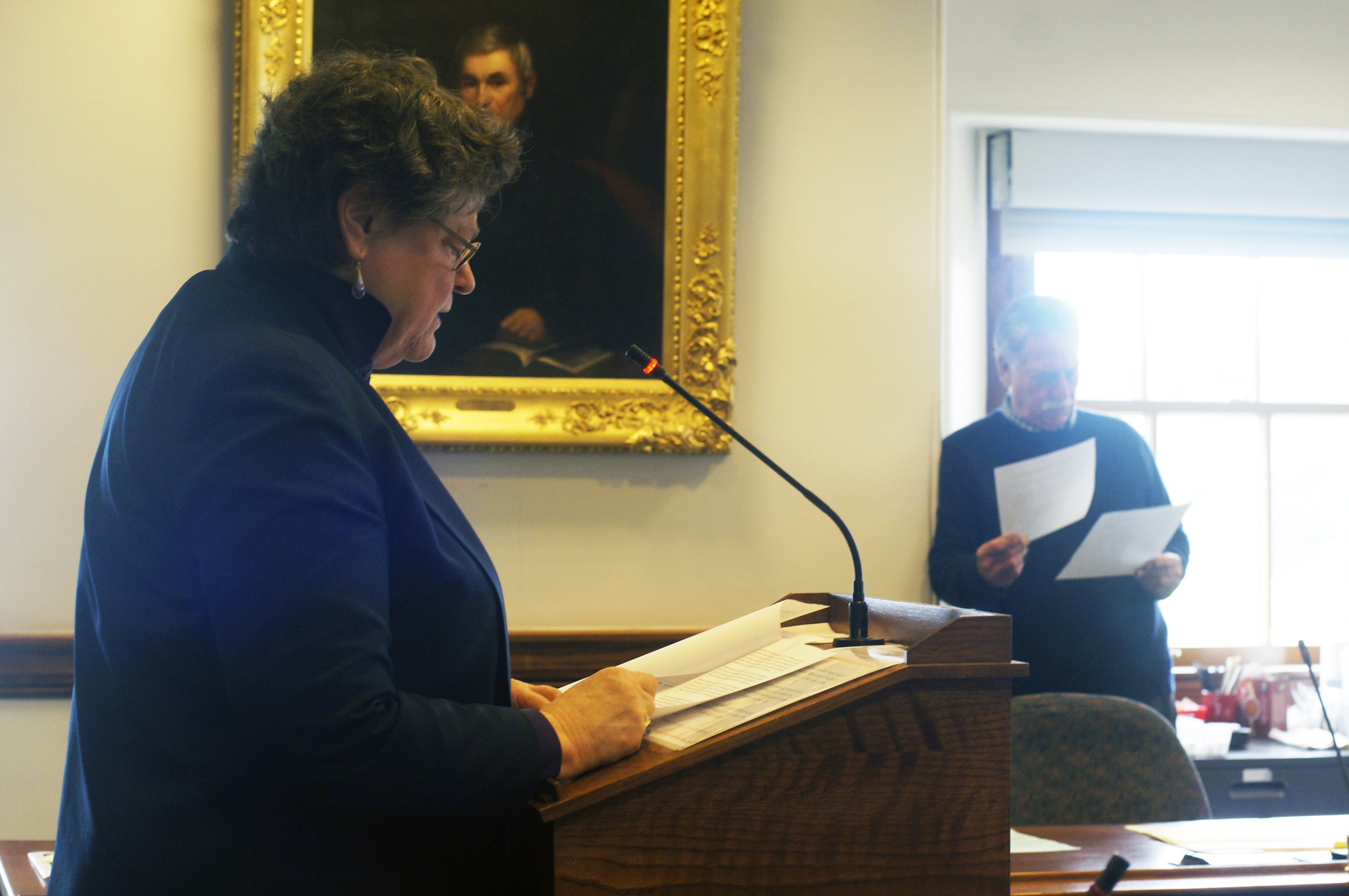
Beacon talked with third-term state Rep. Charlotte Warren (D-Hallowell), the House chair of the legislature’s Criminal Justice and Public Safety Committee, the body where many of the criminal justice reform bills were heard this last session. Warren, who before seeking office taught social work at the University of New England and was the mayor of Hallowell, requested the committee as a freshman lawmaker because she believes mass incarceration is the civil rights issue of our time.
‘Possession amounts we’re basing our charges on is way off’
For criminal justice reformers like Warren, the first legislative session with Democratic control of both chambers and the governor’s office, allowed for some modest reforms. Legislation creating a permanent panel to review instances of lethal force used by law enforcement and mandating county jails provide for in-person visitation was passed into law. However, there is still considerable institutional resistance to measures that attempt to reduce the number of people being held in Maine’s prisons and jails.
One measure, a bill introduced by Rep. Rachel Talbot Ross (D-Portland), would make it easier for people to qualify earlier for reentry programs outside of the prison system, such as work release centers, halfway houses, sober houses and transitional housing. Another major priority for criminal justice reformers, a decriminalization bill sponsored by state Rep. Pinny Beebe-Center (D-Rockland), would increase the possession amount for “schedule W” drugs, such as cocaine, oxycodone, methamphetamine or fentanyl, at which a felony-level charge is triggered. It would also compel law enforcement officers to determine drug trafficking by motive, rather than by arbitrary quantities.
Mills has so far declined to sign Talbot Ross’ bill into law, while Beebe-Center’s bill is being held back from a vote until next year, at the request of the governor’s office. These decisions have raised concerns about how open the former attorney general will be to an overhaul of the criminal justice system.
Warren said Attorney General Aaron Frey, who has given input into the specifics of the decriminalization bill, will be participating in talks with the governor’s office this summer and argue on behalf of the proposal.
Beacon: Why is Beebe-Center’s decriminalization bill a priority?
Warren: We certainly have known for a long time that the amounts that we’re basing our charging on is way off. I mean, it’s way off. Our drug policies are set up right now on the idea that people are buying it one pop at a time behind a restaurant. So, you can literally get busted and charged with trafficking for having just your own usable amount, however much you might use over a day, two days, three days. [Trafficking] is a felony charge, which you’re never going to be able to escape. That needs to change.
That’s the thing that I hear from district attorneys. They say, “No, Char, we’re not going after the users, we agree with you.” But when I look in the newspaper every day and read those articles, those aren’t kingpins.
Beacon: How open are people you’ve talked with within the criminal justice system to decriminalization?
Warren: We worked hard to make sure we had conversations with everybody that was going to be affected by this. We had conversations with the attorney general’s office. We had conversations with the district attorneys. We moved a lot of people. People came into that public hearing with, “Here’s where we have been, we’re willing to come this far.”
The governor’s office is not willing to move at all yet. Do I have hope that she will? Yeah. But I think this is an example of where we need to lead her.
Beacon: How open is Mills to criminal justice reform?
Warren: I was psyched going into this session now that Democrats control the House and the Senate and the Blaine House. We have wasted a lot of time the last several years, as far as I’m concerned, trying to make some serious changes that need to be made.
I’ve been on the opposite side of Janet Mills for a long time, [since] when she was attorney general. So I didn’t come into this session thinking it was going to be all roses. I knew that the work that came out of my committee was going to be in the biggest conflict with her.
In 2015, former Gov. Paul LePage missed a deadline to veto a number of bills, one of which de-felonized first-time, simple possession of heroin, a bill that moved through Warren’s committee.
Warren: So, the next year, the attorney general [Mills] put in a bill to re-felonize simple possession. She was our biggest opponent.
[Mills] came up as a prosecutor. She’s been working in a system for a very long time that, quite frankly, has treated her well. She is a cop. She believes in law and order.
During the legislative session, Warren said that she arranged for criminal justice committee members one afternoon to go to court to observe arraignments for drug charges. For some committee members, that day dispelled many illusions that the criminal justice system was meaningfully connecting people suffering from substance use disorder to treatment, she said.
Beacon: What did observing court reveal?
Warren: One young woman stood out. Her hair was in front of her face. She was picking her fingernails. She didn’t look up. [Maine Superior Court Judge William R. Stokes] said to her, “Alright, so you have two things to do. You got to pay your fine. And you got to get in treatment, right? So you’re going to do that, right?” And she was like, “Yeah, yeah, I’m going to,” without ever looking up. And we all knew, she can’t pay that fine. And how [is she going to] find treatment? It’s a fairy tale.
[Later,] I said to Judge Stokes, “Do you sometimes feel like you’re acting in a play?” And he said, “Absolutely.”
I know that for one of the Republicans on the committee, it changed the way he thought about it. He referenced that over and over. We all knew there was no way she wasn’t going to end up right back there.
Beacon: So, there are some Republicans with you on this?
Warren: Oh, there are Republicans in the general legislature who do not agree with what’s going on. That’s why I think if we can get some of this stuff out on the [House and Senate] floor — bills like decriminalization — we can get some movement. There’s a reason the governor’s office wanted us to hold that bill over [until next session next year].
‘If we build it, they will fill it’
During the session, Warren also opposed the transfer of women, who were being held in an overflow unit housed within a men’s facility, to vacant housing pods at Long Creek Youth Development Center. While there was concern that the women’s close proximity to the men was violating MDOC’s safety protocols, the transfer was also seen by many reform advocates as a path to greater expansion of the justice system.
The proposal has been tabled for the moment.
Beacon: What should happen with Long Creek Youth Development Center?
Warren: We should be closing that facility and selling that property — full stop. We should be emptying that facility of children, which means building community mental health services. Maybe there might need to be a youth forensic unit for the very small percentage of kids who are in situations where they actually pose a public safety threat. But there are not a lot of those. It was built to serve so many children. We need to close it down and sell that property. That’s how I feel.
Under LePage, facilities bonds were approved to renovate and expand the Maine Correctional Center in Windham. While the issue of building new facilities and expanding the prison system was not taken up by Warren’s committee this session, she felt it should have been.
Beacon: Should Maine be building new prisons?
Warren: If we build it, they will fill it. Always, we do. In my mind, it’s a huge expansion of incarceration that we should be stopping right now.
We had a Republican governor, and everything that went into the plan for building this facility came about under someone that I vastly disagree with when it comes to criminal justice policy work. We should be pulling that down off the shelf and looking at what we are building. Why are we building it?
Beacon: What do you want the Criminal Justice committee to be working on next year? What would move the needle?
Warren: It’s got to be built on experience, on what’s working in other states. Right now in Vermont, if you get busted for drugs, you are going to get put into treatment. They are not going to try to incarcerate you as some middleman treatment, they’re going to put you into treatment. Imagine if we did that. Imagine if we stopped using the criminal justice system as the middleman for so many other things — but actually just did the things.
We think, “Well, if we put this felony charge on somebody and then if they go successfully through drug court, they can get rid of it… blah, blah, blah.” Just put them in treatment.
(Top photo: State Rep. Charlotte Warren, chairing the legislature’s Criminal Justice and Public Safety Committee. | Cara DeRose)

 Daily Updates