

It is about more than the soup.
Anne Schroth, healthy aging coordinator at Healthy Peninsula, said a volunteer for the organization’s food delivery program recently told her that she picks up soup to deliver to people around 2:30 in the afternoon, making seven or eight stops in the Blue Hill Peninsula and Deer Isle areas, and doesn’t usually return from the delivery run until around 7:30.
“[That’s] because everyone wants to talk, everyone wants to chat, and she understands that she’s their only contact really,” Schroth said. “It’s not just a food security visit, it’s also a socialization visit.”
Advocates like Schroth say an increasing issue in the state with the highest median age in the country is that older Mainers — who are often reminded that they are at higher risk from COVID-19 — are becoming more and more isolated as the coronavirus pandemic drags on.
Those in the healthy aging community were already worried about isolation among older individuals before the pandemic struck. But Patricia Oh, age friendly community consultant with AARP Maine, said the onset of COVID-19 has made the issue worse by forcing the cancelation of many socializing opportunities for older people, such as group meal events.
“All those opportunities shut down, and that left people pretty isolated,” she said.
Lesley Fernow, president of Central Hall Commons, a multigenerational center in Dover-Foxcroft that offers community outreach programs, agreed that isolation among older adults has grown during the pandemic.
Fernow, who is 69-years-old, said the changes in socializing brought on by the pandemic have been difficult to deal with, even though she still maintains an active schedule.
“I certainly have experienced the sensation of missing people more than anything [else],” she said.
While the changes to social interaction have impacted many older individuals, Fernow said it’s a particularly acute problem in nursing homes, especially among those with dementia.
“They have had a fairly active decline in their mental state, in their cognition, that the staff at the nursing home feel is directly attributable to not being visited by family and not understanding why people have abandoned them and not understanding who people are through the window or on the iPad screen,” Fernow said.
Schroth, from Healthy Peninsula, said an additional challenge of dealing with the increasing isolation in older populations is that many people don’t want to ask for help.
Given that, Schroth said it’s important that advocates continue to focus on finding innovative solutions to isolation among older adults, rather than just waiting for the pandemic to end.
“We have to start thinking really creatively about how to encourage people to make connections in a time like this and not just throw up our hands and say, ‘Well, soon COVID will be over,’ ” she said. “Because I don’t think it necessarily will be.”
An additional challenge in a rural state
Advocates say another complicating factor is that Maine is the most rural state in the country, according to data from the last U.S. Census.
One reason rural areas present an added challenge is the dearth of public transportation options, Fernow said.
“In a rural area, you have to be able to drive,” she said. “They don’t have any public transportation to speak of … it’s pretty bare bones. So if you’re an older person who lives even half a mile or a mile out of town, if you don’t have a vehicle and you don’t have someone who can pick you up and drive you, you’re stuck.”

In addition to transportation issues, internet connectivity is a problem in many rural areas of Maine. The state was ranked among the 10 worst for internet coverage in a 2020 report by BroadbandNow Research.
As Zoom calls and other online methods of communication have become the favored way to stay in touch during the pandemic, Oh of Maine AARP said the low internet connectivity rate in rural areas has created a situation where many older people are being left behind.
“For older folks who either live in areas where broadband isn’t a possibility or who just didn’t have the technology in their home, they became pretty isolated,” she said.
Tom Meuser, director of the Center for Excellence in Aging & Health at the University of New England, said the pandemic has made it clear that addressing inequities in broadband access in Maine is essential.
“You can’t live a fully engaged life in today’s world without electronic access,” he said. “So that’s becoming a priority for many.”
Communities leading outreach efforts
Even as the pandemic has created additional challenges for those working to fight isolation among older adults, there are many efforts underway to help Mainers connect.
Jean Saunders, director of Age Friendly Saco, a volunteer group that helps people in the city stay in their homes, said the organization has created a program to provide groceries for those in need and has also applied for a grant for 25 tablets to help older individuals connect with others.
Saunders said that the group started making wellness calls to all Saco residents over the age of 70 after the pandemic struck — something Schroth at Health Peninsula said her organization is also doing with those over the age of 65.
Saunders said the calls and other initiatives are a good way to ensure older people have interaction with others. But that desire goes both ways, she said.
“Most of our volunteers are over the age of 60,” Saunders said. “So we too struggle with how do we all stay connected.”

The concentration of ages among those who work in the healthy aging community is something Fernow is concerned about. She said an essential part of providing effective services to older people is getting individuals from across the age spectrum involved.
“It is very clear that we need an army of younger people to begin to take an interest in older people,” she said. “There has been a gap, and a lot of people who are in the forefront of the leadership … are themselves aging.”
Oh said communities around Maine have been taking the lead in developing programs to help older individuals connect. But she said state government is working on initiatives to address issues, such as the lack of rural transportation in the state, that make it more difficult for older people to connect. The state’s Office of Aging and Disability Services did not respond to a request for comment about what actions it’s taking to combat isolation among older adults in Maine.
Additional efforts to combat isolation have taken place at the University of New England, where Meuser said the Center for Excellence in Aging & Health has done online peer connection groups. Those sessions typically involved a facilitator and a group of older adults talking over Zoom, he said. Meuser said that program has been on a brief hiatus but is starting up again.
He added that the center has helped organize conversations with older adults in other countries.
Meuser said helping older adults connect is extremely important. However, he cautioned that older people shouldn’t be viewed as incapable of helping themselves during this crisis. Meuser said mental health issues during the pandemic have been a challenge for all age demographics and, in some cases, older adults’ wealth of experience can help them better weather a storm.
“You don’t make it to age 80 or 90 without having a lot of strength for coping with life’s ups and downs,” Meuser said. “And I think many older adults would say they’re tapping into those strengths.”
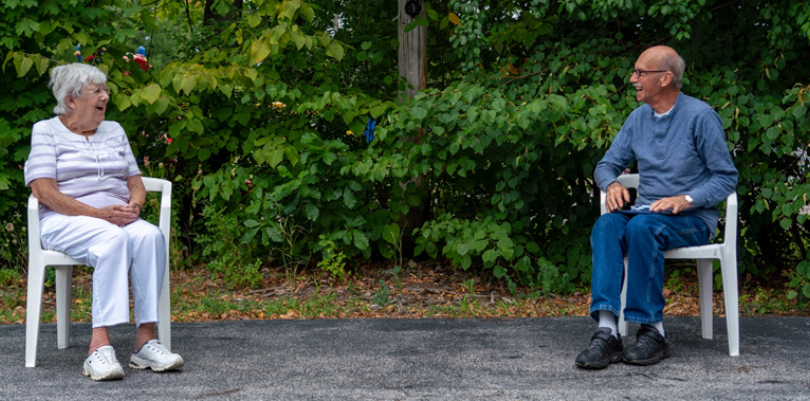
Top photo: Connie Boutet and David Steed in Saco in September. David, a technology volunteer through Age Friendly Saco’s Technology Handy-Helpers program, helped Connie set up and understand her tablet and cell phone. |Courtesy Andrew Dickinson, City of Saco

 Daily Updates