

From talking points to results
Maine’s elderly have become a political football. Not a month goes by without Governor Paul LePage claiming he has the needs of the “truly vulnerable” in mind—particularly the elderly. Whenever he opposes doing right by regular Mainers—whether through a minimum wage increase, greater access to health care, or just sharing state revenue to fund local fire departments—LePage will inevitably claim that the public good in question will harm seniors.
Never mind the fact that many seniors directly received raises when the minimum wage went up or that Medicaid expansion will literally allow others to get the oxygen they need to breathe. And never mind that LePage has consistently proposed to cut prescription drug assistance for tens of thousands of elderly and disabled Mainers, refused to build senior housing, and has worked against efforts to clear the 250-person wait list for Meals on Wheels.
Although it is strictly rhetoric for LePage, and far too many other politicians, the issues underlying these cynical politics are all to real and deserve our attention. We should be asking ourselves: “How will we care for Maine’s rapidly aging population?”
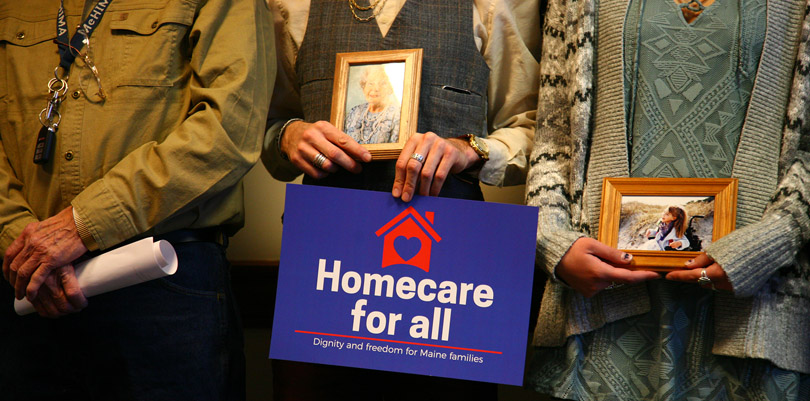
In November, as the LePage administration comes to an end, Maine has the potential to set the gold standard for the rest of the country for what it means to take care of our seniors, through the “homecare for all” ballot measure. The Secretary of State just announced that more than 64,000 Mainers signed petitions supporting the iniative, ensuring the measure will be on the ballot in 2018.
This referendum will likely become one of the likely topics in the gubernatorial debate this election year and it has the potential to move the idea of elder care away from the cheap talking points of dishonest elected officials like the Governor, and towards actual relief for people who cannot wait any longer.
Forced out of their homes
A few weeks ago, homecare worker Miri Lyons had to make an impossible decision. Despite the fact that she was responsible for ensuring her clients were fed, bathed, clothed, medicated, and generally cared for, she was paid just above minimum wage and could no longer support her family. Forced to find better paying jobs, she had to leave her 90-year-old client, whom she loved tremendously. A few weeks later, like so many other Maine seniors, her client was forced to go to a nursing home simply because she had a hard time performing a few tasks around her home and was unable to find someone to replace Miri.
Rarely do people at the end of their life want to leave all the people and places that constitute their home to move to a facility, sometimes far from those they love.
While it may be hard to believe, even veterans face this challenge. Though they have served our country in war, too many veterans can only find short-term homecare. When they can’t get extended help with a few things around the house, they far too often have to leave their homes and live in facilities far away from their loved ones. While many expect Medicare or VA benefits to cover these costs, the sad fact is that the only public program that will help people in this situation is Medicaid, so even veteran families end up spending down their whole life savings in order to qualify for the needs-based program.
Other families do what Bonnie Laughlin did when her mom began to lose her memory. She was able to get some help, but was still responsible for more than 100 hours of her mother’s care each and every week.
“It was a full time job preparing meals, feeding Mom, changing her many times a day, bathing her, administering medications, helping her do bed exercises, dealing with medical needs that came up, such as an occasional infection, and talking and trying to soothe, cheer, or reassure her,” Bonnie said. “For over 22 months, there was never a full night’s sleep for Mom or for me. Most weekends I was the only person caring for Mom from about 1:00pm Friday to 8:00am Monday morning.”
As you might imagine, this situation places stress, not just on seniors, but on their families as well.
 Many Mainers can also relate with Debbie Bourque, who cared for her husband Roland, who suffers from Alzheimer’s, until she was recently forced to put him in a nursing home. Prior to that, she paid out of pocket for three hours of help each week.
“I own and operate a cleaning business and in order to be with Roland I’ve had to cut back on the cleaning considerably to be home,” Debbie explained last month. “Money is tight to pay for care he needs, and whatever money we had saved for retirement is quickly depleting.”
For the workers, mostly women, who provide care professionally, it isn’t any easier. Maddie Hart of Auburn cares for clients with traumatic brain injury, down syndrome, and autism who need assistance to move through their daily life but don’t need to be in a facility. The starting pay at Maddie’s agency is minimum wage.
“I rely on food stamps and Section 8 to keep my son fed and housed,” she said. “My mother works as a nurse and, thank to the Affordable Care Act, I can get health insurance through her. But that will only last for a few more years.”
Similarly, Leighann Gillis has spent six years caring for a young woman who “spreads happiness wherever she goes,” yet is diagnosed as having an intellectual disability, as well as being autistic, non-verbal, and bipolar. In order to remain with her client over the years, Leighann has been without health insurance or paid time off, even for illnesses, and has had to suffer cuts in pay and work two additional jobs.
These are all signs of a deeply dysfunctional society, where seniors, their families, and workers each aren’t getting what they need. By 2030, over a quarter of a million seniors in Maine will require some kind of assistance to live at home. We have a long way to go to build a system that can actually work for everyone.
Homecare for All
The Homecare for All referendum would reform nearly every aspect of this system. First, it would ensure that everyone—not just families poor enough to qualify for Medicaid—can access homecare. The money for this comes from partially closing the loophole that allows individuals who make over $128,400 a year to avoid paying Social Security payroll taxes on their extra income.
Second, it would increase reimbursement rates for all care workers in the state, including those currently paid by Medicaid, to ensure more livable wages. Not only would this help many working women pay the bills, it will also help agencies attract more workers interested in better-paying jobs.
Third, the whole system would be governed by a democratically-elected board made up of the families who need homecare services, homecare agencies, and the workers on the front lines providing care. This will ensure that care for the elderly is no longer dependent on the politicians more interested in talking points than real progress.
Understandably, after seeing the way the legislature has modified so many referenda that have been passed over the last few years, many people may be skeptical about this one sticking–even if the voters pass it. However, because of those past experiences, there are a few provisions built into this referendum that would be difficult for legislators to undo. First, the money never goes into the state’s “general fund.” The board is the governing body of the fund, and they have the authority to contract directly with providers to create new programs to fill the unmet needs in the system. Second, politicians aren’t going to want to mess with this voting bloc. Nearly six in ten Mainers are (or have been) family caregivers for a senior or a loved one with a disability, just like Bonnie and Debbie. And all of us hope to be seniors at some point. Everyone knows this demographic trend in Maine will define our future more than any other.
I pity the politician that tries to take us backwards.
As Ai-Jen Poo, co-founder of Caring Across Generations, has said many times: Care will define our future like no other issue. A hundred years ago, factory jobs had taken over the economy. They paid little, were unsafe, and undesirable. But we decided as a society, thanks to regular people coming together, particularly in labor unions, that we wanted change. We made those jobs pay good wages with more protections, which stabilized our society and built the American middle class. With those jobs now leaving Maine in droves, and with new service-sector jobs, particularly concerning care, growing exponentially, we face a similar situation. Change is within our power. We can make a society that works for seniors, their families, and the workers who take care of them–but we have to decide it’s what we want to do.
This November, voters will get to make that choice at the polls. It’s time to move past the talking points, and actually get it done.

 Daily Updates