

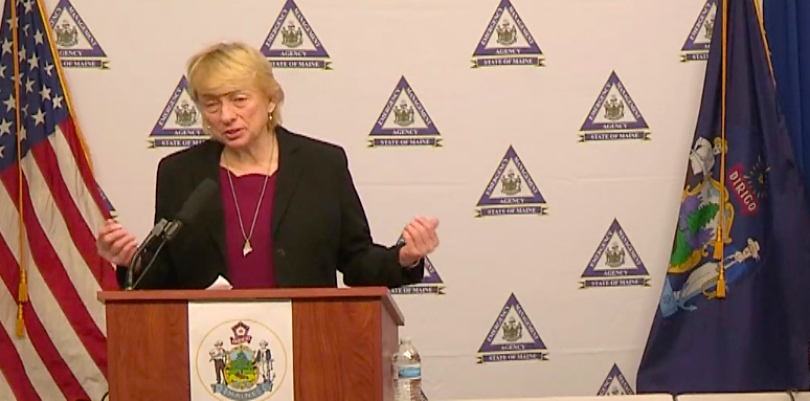
Over one month since declaring a civil emergency due to the COVID-19 pandemic, Governor Janet Mills announced Thursday that she has signed an executive order suspending most evictions in the state and unveiled a rent relief program that could provide one-time payments of up to $500.
Anti-poverty advocates who have been calling for such measures say the housing order is an important first step but far from enough to fix “the severe weakness[es]” within the state’s social safety net, which have been amplified and exacerbated by the current public health crisis.
“It’s what we can do right now,” Mills said at a Thursday afternoon press conference in response to a question from Beacon about what additional steps may be taken. “We’ve put this together kind of on the fly, found some money for at least a one-time payment for peoples rent. And the bargain is the landlord accepting this payment or partial payment will commit to [not evict their tenant].”
For the duration of Maine’s civil emergency, the executive order also mandates that writs of possession – the document that allows for the eviction process to begin – not to be served or issued against renters while landlords who try to illegally evict renters could face six months in jail and up to a $1,000 fine.
The rent relief program, which is overseen by the Maine Housing Authority, is designed for renters whose ability to pay their rent has been affected by the pandemic. Eligible renters can apply for a one-time payment to their landlords of up to $500. Renters who live in subsidized housing are excluded.
Edier Ramírez, a member of Presente! Maine, expressed concerns about the limits of the assistance program.
“The Latinx community is in and has been in crisis long before COVID-19,” explained Edier. “Now we are being asked to stay home, but most of us have no idea how we’ll pay the rent. There are already confirmed cases of coronavirus in our community and we live and work in such close quarters with one another that I fear what will happen if there is no relief for us and people decide to go back to work before it is safe. We need full cancellation of rent now to safely quarantine at home.”
Craig Saddlemire, manager of the Raise-Op Housing Cooperative in Lewiston, praised Mills’ announcement as “a welcome one” and said it should “provide at least temporary assurance to many people in Maine.”
“But these efforts still leave too many people with no relief and we need to keep all people in stable housing in May and beyond and that will take continued actions by all of our elected officials,” he added.
Recession could further threaten housing stability
Nearly a third of renters across the country were unable to pay their rent in the first week of April and with a recession looming that is already being compared to the Great Depression, anti-poverty advocates are calling for the Mills administration to do more for renters.
“The patchwork of assistance programs we are forced to navigate to survive in this moment exposes the severe weakness of our public safety net, which we are now rushing to rebuild long after it was needed,” said Ben Martineau, an advocate leader with Homeless Voices for Justice, in a press statement following the governor’s announcement.
“Applications for unemployment insurance are backlogged, housing assistance waitlists are growing, and federal stimulus checks are not reaching many of the poorest households who need them most,” he added.
On March 30, a coalition of housing and labor advocates — including Homeless Voices for Justice, Raise-Op Housing Cooperative and Presente! — launched a petition that received more than 1,800 signatures calling on Mills to forgive rent and mortgage payments during the crisis. It also called for suspending evictions and foreclosures until 90 days after Mills’ state of emergency order is lifted.
“In order for Maine to fully recover from this crisis, we need a stable foundation from which to rebuild our economy, and that begins with the assurance of adequate, permanently affordable housing,” Saddlemire said.
He said the commitment to making sure that all Maine people are safe and housed must go further than rent relief.
“Maine leaders must invest in permanent shelters, transitional and supportive housing for the over 2,000 people living without homes in Maine,” Saddlemire said. “We must create a state housing assistance program that covers all those applicants on waiting lists for public housing assistance. We must strengthen our regulatory power and end housing discrimination practices carried out through restrictive zoning and lease requirements. And we cannot expect our largest service centers to solve all of Maine’s housing needs on their own.”
Photo: Governor Janet Mills gives a briefing on the new housing measures on April 16. | Still from Maine Public stream

 Daily Updates