


Last week, South Portland residents overwhelmed a virtual meeting between the Maine Department of Environmental Protection and South Portland’s Clean Air Advisory Committee (CAAC). The meeting was held to review proposed changes to the operating license for a petroleum storage facility in South Portland owned by Global Partners LP, where emissions have violated the Clean Air Act for over a decade.
The DEP meeting was scheduled after a public hearing on the issue was cancelled in early March due to the COVID-19 pandemic.
Despite the June 1 meeting not allowing public comment, residents quickly maxed-out the virtual room’s 100 person capacity. South Portland residents in attendance say they are concerned that the state is failing to adequately regulate Global while the energy giant continues to emit pollutants into the region’s air.
Public comment on Global’s proposed revisions remains open, and will close on June 17.
Violations of Clean Air Act
Global was forced to propose revisions to their operating license after the U.S. Environmental Protection Agency filed a consent decree in federal court against the company in March 2019 for exceeding Clean Air Act emissions standards for over ten years.
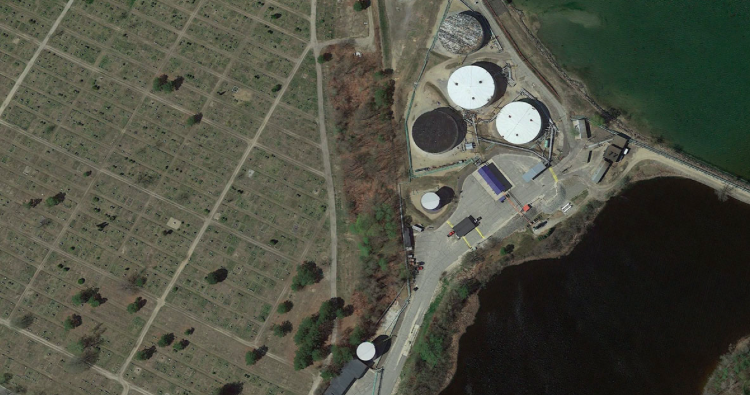
The Global facility stores asphalt and #6 heavy fuel oil in heated tanks, which keep the substances in liquid form. The heating causes volatile compounds in these petroleum products to vaporize and are a substantial source of air pollution.
The EPA charged that Global exceeded emissions limits of volatile organic compounds (VOC’s), an environmental health hazard that can cause respiratory issues, headaches, nausea, organ damage, and cancer.
Global owns only a few of the 120 petroleum storage tanks located in South Portland, and they are not the only company in the city charged with violating the Clean Air Act.
On March 29, the EPA filed another consent decree for violations of the Clean Air Act, this time against Sprague Resources. The consent decree outlines violations at Sprague’s petroleum storage facility in South Portland and another facility in Searsport, Maine, as well as violations at facilities in Massachusetts, New Hampshire and Rhode Island.
Protect South Portland (PSP), a citizen-led environmental watchdog and activist organization known for preventing ExxonMobil subsidiaries from piping Canadian tar sands oil into the city in 2014, has been pushing the Maine DEP to increase air quality testing and regulatory enforcement at Global and other petroleum storage facilities across the city.
Roberta Zuckerman, an organizer with PSP, said the lack of action on this issue from the DEP is a direct threat to public health and is an example of environmental injustice.
“There are kids going to daycare near the tanks, we have a community center there and high schools. I figure there are about 1,500 kids going to school near the tanks, not counting the day cares,” Zuckerman said.
Further, she noted, “air pollution has been identified as an indicator leading people to be more vulnerable to COVID-19. Many more people of color are contracting and dying from COVID-19 than their representation in the general population. Around our country, communities who live near oil infrastructure tend to be lower income and minority communities.”
Removing oil storage tanks is among the state-level demands being made by Black Lives Matter Portland.
Zuckerman pointed out that “around the country, communities around oil infrastructure are referred to as ‘sacrifice zones’ [because of] the fact that the community’s health is being sacrificed as part of the ‘cost’ of oil companies doing their business.”
“Global is a Fortune 500 company, and they’ve been making tons of money doing their business, but they need to do it responsibly,” Zuckerman said. “We can’t pay with our health for their profits. There is the capacity and the technology to monitor and measure what is coming out of the tanks, and to treat it. What is needed is the will to do it.”
Fear that proposed revisions will not reduce emissions
Despite Global having long exceeded emissions standards, the proposed license revisions “could actually make things worse,” according to Zuckerman. The proposed revisions include a cap on the facility’s throughput, limiting the annual quantity of petroleum products that can pass through the facility. However, Zuckerman said the proposed cap is five times higher than the facility’s normal throughput, adding that under the proposed revisions, “[Global] can increase their throughput and increase their emissions and still stay within their permit’s limits.”
The proposed license revisions also do not require Global to identify or quantify the pollutants they release into the air.
David Falatko, an environmental engineer who lives near the Global tanks in South Portland, said he has asked “that Global demonstrate compliance with their permit limits, meaning they would take samples and monitor their effluent emissions and measure air flow to determine mass discharge of VOCs.” Falatko has also suggested that the DEP require Global to treat the emissions coming from the tanks, adding, “they could very easily add on vapor treatment to contain those emissions if they are shown to be high or hazardous to health.”
In addition to suggesting new monitoring and treatment requirements, Falatko has used data from Global and the DEP to argue that by changing the way emissions are calculated at the facility, Global has grossly underestimated their emissions for years. Currently, petroleum storage facilities in Maine self-report emissions data to the DEP, hiring their own staff or contracting private labs to compile emissions data. Falatko has also used EPA air quality data to estimate that petroleum storage facilities in South Portland are responsible for 50 percent of pollutants in the city’s air.
DEP withholds regulatory action, citing lack of data
While members of the public like Zuckerman and Falatko were unable to directly address the DEP on these matters at Monday night’s meeting, South Portland’s CAAC did.
“Regarding the possibility of inserting a VOC monitor into [the storage tanks] as a way of measuring real time emissions – I realize it’s more complex and expensive, but we are talking about people’s health here,” said Tom Mikulka, an environmental chemist and CAAC member. “We cannot ignore the fact that there are compounds emitted which are potentially harmful to the residents of those neighborhoods.”
In response to these concerns, DEP officials repeatedly pointed to a legislative resolve passed in February, LD 1915, which requires the DEP evaluate and report on emissions from petroleum storage facilities across Maine.
“We really don’t have enough information yet to know [what] is a viable means of monitoring, especially when you’re talking about asphalt and #6 oil emissions, versus something that has emissions that is much lighter on the VOC spectrum,” said Eric Kennedy, a DEP licensing and compliance official. “But that is something we’re looking into as a part of that legislative resolve study.”
“We are working really hard to gather information and not make all of the decisions right now,” said Jane Gilbert, a DEP licensing and permit expert. “The permit itself will contain specifics as to the facility’s emission limits and it will contain directives for how they will demonstrate compliance with the emissions limits.”
Gilbert did not outline what the emissions limits might look like, or how Global will demonstrate compliance.
Addressing the issue of Global’s proposed throughput caps, Kennedy said that the suggested caps of 50 million annual gallons of #6 oil, and 75 million annual gallons of asphalt were not intended to reduce Global’s emissions, but that those caps were imposed by the EPA’s consent decree to ensure that the Global facility would be categorized as a minor emissions source. If the facility were to exceed these limits, it would be re-categorized as a major emissions source, requiring stricter regulations to mitigate pollution and increased involvement of the DEP.
After the meeting, Zuckerman commented on the issue of being a major versus minor emitter classification. “There was discussion of Best Available Control Technology which can reduce emissions between 95 and 99 percent. But so long as Global manages to evade being classified as a major emitter, under current regulations, BACT requirements would not apply to them.”
‘Sadly…it’s cheaper to pollute than it is to control’
By the end of the meeting, many of the CAAC’s questions were left largely unanswered, with the DEP citing the need for data from the legislative resolve study before offering specific recommendations for emissions monitoring, prevention and enforcement at the Global facility.
Residents and Members of the CAAC view the revision of Global’s operating license as an opportunity to impose emissions restrictions on Global and to protect the health of the surrounding communities.
Until then, Global continues to operate without any new limits on throughput or emissions.
Near the end of the meeting, Mikulka addressed the DEP on the lack of regulatory action and the issue of the new charges against Sprague. “For 14 years, [Sprague] was modifying tanks and getting away with emitting excessive amounts of potentially harmful odors from #6 oil and asphalt,” Mikulka said. “They got away with a lot of polluting, without having a permit. Sadly, it has shown the public, me being a part of that, it’s cheaper to pollute than it is to control. And a $350,000 fine for 15 years worth of polluting neighborhoods, is chump change.”
Top photo: Storage tanks owned by Global Partners in South Portland. | courtesy of Protect South Portland

 Daily Updates