

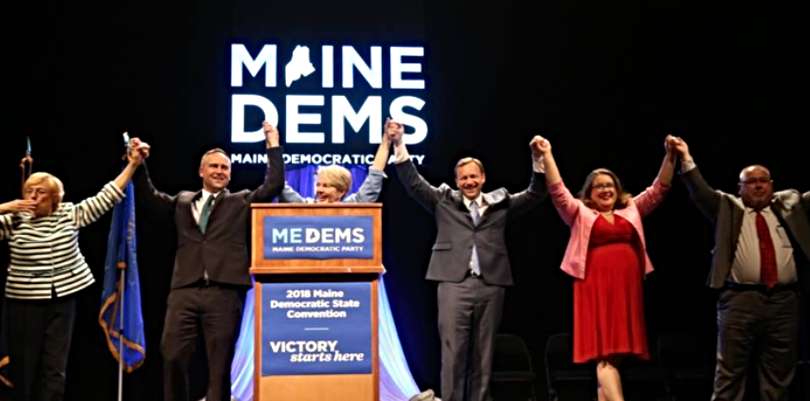
Over the weekend, hundreds of Democratic activists, organizers, and candidates descended onto the Colisée Center in the heart of Lewiston to conduct their biennial state convention, a two-day event that lays bare the beautiful messiness of Maine progressive politics.
For me, the location this year held special significance because it is where I attended my first state convention in 2010, alongside my grandfather–a lifelong Auburn Democratic and Labor activist who proudly initiated me into the raucous, archaic, perplexing, and utterly enjoyable world of the Maine Democratic Party’s highest governing body.
While state conventions are perhaps most readily known for showcasing that year’s major candidates for elected office, those floor speeches represent the tip of the iceberg of what happens over the weekend.
The state convention is comprised of delegates from each of Maine’s 16 counties who were elected by their neighbors at their respective town Democratic caucuses in March, who in turn travel to the convention to debate and ratify the party platform, adopt new rules, and–perhaps most importantly–elect representatives from the county delegations to the Democratic State Committee, which serves as the state’s governing body between conventions. It’s the State Committee that then elects the state’s chair, officers, and executive committee, meaning the decisions made at the convention set the stage for the core operation of the Democratic Party for the next two years. In presidential years, the state convention is also the body that elects delegates to the Democratic National Convention, who in turn select the party’s nominee for president.
The labyrinthian caucus/convention system is a vestige of mass political organizing in America’s earliest years, when communication and travel were difficult and political power was concentrated in relatively few hands, so party bosses would come together and meet behind closed doors to select candidates for office up and down the ticket.
Today of course, that system of candidate selection has largely given way to state-regulated primary elections, however the caucus/convention system remains the way the parties continue to internally organize themselves.
What were once smoky back rooms for the political elite, though, are now stadium floors filled with grassroots activists, members of the press, and candidates for offices up and down the ticket looking to get face time with–and make their cases to–the local volunteers who they hope will form the backbones of their primary and general election campaigns.
What results is an amazing and transparent weekend of controlled chaos where at various times you will find rooms full of hundreds of delegates arguing (within the stringently enforced confines of Robert’s Rules of Order) about everything from comma placement in a proposed platform plank to core questions about what it means to be a Democrat in 2018. In other moments, you might get a chance to corner primary candidates for offices ranging from U.S. Senate to register of probate and grill them face-to-face about their stances on the issues that you care about.
You will see party staff desperately trying to keep events on schedule, while raging floor debates dismantle their best-laid plans. You will see people burst into spontaneous applause and suspend debate immediately when they hear the announcement that boxed lunches have finally arrived.
You will see organizers for candidates on their feet for two days running on nothing but caffeine and adrenaline as they fight for volunteers’ attention and for the best yard-sign placements outside of the convention center.
You will hear from candidates for Congress and governor making their pitches to the crowds as their respective supporters try their hardest to outdo one another in their displays of enthusiasm. And you will hear from speakers as prominent as national rising star Texas Rep. Joaquin Castro, and as courageous as Deering High School student Allan Monga–who successfully fought to be allowed to compete at one of the most elite poetry recital competitions in the country after being barred because of his status as an asylum seeker.
For me, I got to see my grandfather, who passed away last year, honored and memorialized along with other activists who spent their lives proudly volunteering for those local candidates that they believed earnestly would fight to make the state a better and more just place.
And I got to see a new generation of young activists coming to their first state convention, ready to see those fights continue.
In the end, in all of its odd glory, this weekend I saw the Maine Democratic Party.
Democratic gubernatorial candidates (from left to right) Janet Mills, Adam Cote, Betsy Sweet, Mark Eves, Diane Russel, and Mark Dion. (Photo: Jeff Kirlin/The Thing of the Moment)

 Daily Updates