

When Richard Evans was campaigning in 2020 for a seat in the Maine House of Representatives in deep-red Piscataquis County, he called up a voter who had some questions for him.
Evans, a Black doctor and a Democrat running in an overwhelmingly white county, started the conversation by telling the man that he would answer his questions honestly, even if the responses weren’t what the man wanted to hear. The two had a wide ranging discussion, touching on health care, jobs, education and family life.
“At the end of the conversation, he said, ‘I am a lifelong Republican, I have never voted for a Democrat in my life. But because you were upfront and honest with me, that meant a lot,’” Evans said, adding that the man committed to getting friends and family to vote for the Democrat as well.
“So I met him where he was and he understood where I was coming from and I understood where he was coming from,” Evans said.
That commitment to openness and honesty served Evans well, as the Democrat went on to win his race for the House District 120 seat — which includes the municipalities of Atkinson, Brownville, Dover-Foxcroft, Lake View, Medford, Milo and Orneville Township — despite running in a county that voted for former President Donald Trump by a wide margin.
And while Evans was likely the beneficiary of a three-way contest that featured a Republican and a conservative independent, he said the lesson from the campaign is that taking the time to listen to people and speaking with them honestly can transcend ideology and political affiliation.
Evans’ experience is indicative of an edict that has perhaps become cliché but still rings true, especially in tight-knit communities around the state: All politics is local. And it begs the question, can more Democrats win in rural areas of Maine?
Following a 2020 election in which Trump won Maine’s largely rural 2nd Congressional District for a second time, Sen. Susan Collins rode to reelection in part by running up the score outside of southern and coastal Maine, and Republicans in the Maine Legislature solidified less-populated places in the state as their stronghold, Beacon sought to explore that question and better understand how progressives can build political power in rural Maine in the future.
In interviews with over a dozen people — including elected officials who have won in rural areas as well as those doing on-the-ground organizing — a narrative emerged: Democrats and progressives can compete across Maine.
In fact, a number have been able to win important races, such as Evans in Piscataquis County, Senate President Troy Jackson in Aroostook County, state Sen. Chloe Maxmin in Lincoln County, U.S. Rep. Jared Golden in the 2nd District, and Craig Hickman in a recent state Senate special election. Most of those areas and counties were places where Trump and Collins also ran strong.
But along with those victories have been myriad defeats in rural Maine and a sense from organizers and candidates — both successful and unsuccessful — that a return to fundamentals is needed: A focus on knocking on voters’ doors, an emphasis on issues that resonate with voters across party lines, and a commitment by the state Democratic Party and other political organizations to invest more in less-populated areas of Maine.
Lay of the land in rural Maine
First, a couple of caveats. Maine as a whole has one of the highest white population percentages in the country, and that is even more true when talking about rural regions in the state. While some people of color do live in such areas, out of Maine’s five most rural counties — Piscataquis, Lincoln, Washington, Aroostook and Somerset — only Washington County was less white than the state average of 94.4%.
Still, rural Maine is not a monolith, as a number of people Beacon spoke with made a point to acknowledge. What is true in Oxford County may not be the case in Aroostook County and, in fact, micro-level politics exist within counties as well.
However, when it comes to the political lay-of-the-land in Maine’s rural areas, many people Beacon interviewed told a similar story of a region that historically voted blue but has gradually become redder over the years.
While that trend became obvious in 2016 after Trump became the first Republican presidential candidate to win the 2nd Congressional District since George H.W. Bush won the entire state in 1988, it predates the former president.

“We had a Trump before in Maine and his name was LePage,” said Isreal Mosley, an organizer in Kennebec County, referencing the state’s volatile former governor who was first elected in 2010, the same year a wave of conservative Tea Party candidates stormed to power across the country.
There are a number of explanations for the shift favoring candidates like Trump and Paul LePage in rural Maine. But for state Rep. Seth Berry (D-Bowdoinham), one of the primary drivers has been a frustration with politics as usual that both Trump and LePage managed to harness through inflammatory, xenophobic rhetoric.
As explained by the think tank Demos, the type of rhetoric used by politicians like Trump and LePage to stoke racial fears is a common tactic deployed by elites to turn working people of different races against one another.
But Berry said while support for figures like Trump and LePage in rural Maine has often taken the form of racialized resentment, he believes a lot of the frustrations tapped into by Republicans have roots in the economic hardships seen in many parts of the state.
“I don’t believe that the support for Trump or the support for LePage was primarily about hatred of others, although it often manifested itself that way … I think there are a lot of folks who supported Trump, who supported LePage and who feel left out of our current economy,” said Berry, whose district is primarily rural and features multiple towns that voted for Trump.
Maxmin, the young Democrat who defeated then-GOP Senate leader Dana Dow in 2020 in Lincoln County, agreed that Republicans like Trump have been able to activate an anger that has been building for a long time in rural areas. And Maxmin said those feelings have been compounded by national Democratic campaigns that have often done a poor job of explaining how their policies would help such regions.
“I don’t think Trump created it, I think he was a response to it,” she said of the conservative shift in rural Maine. “In 2018, since it was so close to the 2016 election, I heard a lot of people talk about how [Hillary] Clinton’s narrative really felt academic and intellectual and just talking about these big ideas that weren’t really connected to what was happening in our community. But when people heard Trump speak, they heard him speaking to the working man and the small business owner and speaking to a former day of glory in our rural communities that we feel has passed us by.”
‘It’s a bit like firefighting’
Given that backdrop and historical progression, how should Democrats and progressives move forward in rural Maine?

To Berry, the party needs to reclaim its mantle as a champion of working people. Part of that effort, Berry said, should be crafting a more disciplined message that avoids a tendency on the left to judge and write-off those who have expressed support for things Republicans like Trump and LePage have said over the years.
“It’s a little bit like firefighting. I’m not a firefighter but they tell me that the idea is to aim the water at the base of the flames, at what is burning, not at the flames themselves. And I feel like we often as Democrats are aiming at the flames themselves,” he said. “We’re criticizing and belittling and debating and getting angry with people about things they say which are not really the things they care about the most.”
The thing people care most about?
“It’s the economy,” Berry said. “People want a society where anyone can succeed and where there is a strong ladder of opportunity for all. And they want to feel that their own standard of living is at least as good as their parent’s generation. And there’s just no reason in this day and age that we can’t accomplish that.”
Tina Riley, a former Democratic legislator whose district straddled Franklin and Androscoggin counties, agreed, saying the path forward for Democrats in rural areas “rests with strong, progressive economic policy.”
Riley, who was defeated in her reelection campaign in 2020, said, “We need to drive the conversation back to why we’re Democrats in the first place” and emphasize a commitment to an economy where the wealthy pay their fair share and no one is left behind. That type of message, Riley said, can attract voters in rural Maine who historically would have been Democrats but have increasingly turned toward Republicans.
Another issue that multiple people Beacon spoke with said has crossover appeal with rural voters is ensuring that everyone has access to health care. Patty Kidder, who ran unsuccessfully in 2020 for the Maine House as a Democrat in the Sanford area, said that topic came up repeatedly in conversations with voters.
“How am I going to afford health care? What am I going to do if I get laid off from my job and I no longer have health insurance? And they are also concerned that if they do have a job and they have insurance through that job, that their copayments and deductibles are too high. That was a really big issue that just crossed party lines,” Kidder said.
Another issue voters across the spectrum find common ground on is protecting Maine’s natural beauty and environment, multiple people said.
Drew Gattine, who recently took over as chair of the Maine Democratic Party after serving as a Westbrook-area state representative, agreed that candidates — including those in rural Maine — should emphasize why they are Democrats.
“We just need to continue to show people in communities across the state that we’re the people that share their values,” he told Beacon in January. “And our values are supporting Maine people, working for fair wages, making sure you get a good education no matter where you live in the state and making sure that you have access to health care.”
One aspect that can complicate that calculus, however, is the racism that politicians like LePage in Maine and Trump across the country have activated. That’s particularly relevant in a state like Maine that has both an overwhelmingly white population and a growing population of color.
Even as the summer of 2020 saw a national resurgence of protests for racial justice after the police murder of George Floyd, Evans — from Piscataquis County — said most people he spoke with were focused on other issues.

Still, Evans said even though race wasn’t a common topic raised by voters he talked to, he said that it’s important to continue to discuss the issue and not simply sweep the country’s problems with systemic racism under the rug.
That’s a message the think tank Demos has also emphasized. In a paper, the group highlighted research that shows that progressives should not separate issues of race from economic messaging, arguing that the “key for cross-racial solidarity, voter engagement, and policy victories is addressing the connections between racial divisions and economic hardship.”
Kathryn Harnish, who ran unsuccessfully as a Democrat in 2020 for an Aroostook County-area seat in the Maine House, said building a multi-racial, multi-class movement in rural Maine is a worthy goal. However, Harnish cautioned that such a movement won’t be built overnight and that progressives should be careful to not frame conversations about racial justice around discounting struggles white people in rural areas may have experienced.
“I don’t want to excuse anything or give people a free pass because they quote-unquote don’t know any better, but sometimes I think running at it head on just makes people more entrenched, so that’s a challenge,” Harnish, who is a contributor to Beacon, said.
For Maxmin, her approach to addressing issues of race while campaigning was to be upfront about her values but also to acknowledge that societal struggles are not a zero-sum situation.
“I support the Black Lives Matter movement and I understand where that movement is coming from and what it’s trying to achieve and I also understand that in my very white community, there are serious struggles here that are incredibly challenging and really, really deep and systemic as well,” she said. “So, I think both of those realities live in my mind.”
Putting boots on the ground
In addition to focusing on popular issues, political candidates and organizers said there is no substitute for person-to-person voter contact, arguing that an aggressive boots-on-the-ground strategy in rural Maine could help Democrats and progressives win in such areas.
While that type of strategy became more difficult in the 2020 election cycle with the onset of the COVID pandemic, some Democrats were still able to do door-knocking, perhaps none to greater effect than Maxmin in her successful campaign in Lincoln County.

Maxmin, who was first elected to the legislature as a state representative in 2018, said a core tenet of her campaign was talking with voters in-person (in a COVID-safe manner).
“An extraordinary amount of effort went into connecting with people and taking the time to get people’s experiences, ideas, hopes, frustrations and problems,” Maxmin said.
During the campaign, one thing that struck Maxmin was how often she spoke with voters who had never before been contacted by anyone associated with the Democratic Party. Maxmin said that reality was part of a general feeling of frustration many rural Mainers expressed about the way both parties run campaigns — a frustration she said was amplified by the 2020 U.S Senate race between Collins and Democrat Sara Gideon, which turned into a high-dollar mudslinging contest, with both candidates blanketing the airwaves with negative ads.
But success in reaching rural voters doesn’t stop at winning an election, Maxmin said. She said it’s also important for candidates to show constituents that they are keeping those discussions in mind while in office. One way Maxmin has done that is by introducing bills based on issues brought up in conversations on the campaign trail.
Berry agreed, saying door-knocking and being responsive to constituents must be key aspects of the progressive strategy. Doing so can often transcend differences in ideology, he said.
“I’m living proof that strong progressives on social and economic issues can and do win in conservative areas,” he said.
Liesha Petrovich, a volunteer in Oxford County with Maine People’s Alliance (of which Beacon is a project), also said in-person organizing is crucial for progressives. However, she added that the deficits Democrats face in rural Maine won’t go away overnight, pointing out that the party didn’t win any legislative races in Oxford County in 2020. Petrovich also acknowledged that the polarized reality of national politics has permeated the state, including rural Maine, making it more difficult for progressives to reach some arch-conservatives who express hatred for anyone associated with the word Democrat.
To help overcome such challenges, Petrovich said there must be a long-term commitment by the state Democratic Party and grassroots groups to invest in candidate recruitment, training and campaign infrastructure in regions across the state.
However, a number of people Beacon spoke with, including Petrovich, said that type of support hasn’t occurred in recent election cycles.
“We don’t have the investments in candidates that we should be having,” she said.

Harnish, from Aroostook County, was also frustrated by the lack of resources provided to candidates in rural areas during the lead-up to the 2020 election.
“I was very disappointed in the investment that was made in races here in the county by the state Democratic Party,” she said. “I had almost zero support from the party, a little bit of support from my county committee, none at a state level and none from the House Democratic Campaign Committee.”
In an email, Gattine — chair of the Maine Democratic Party — said the party “remains focused on the people of rural Maine and will double down in our commitment to showing up for them. We are, and always have, invested in our County and Municipal Committees, and are building the bench for local races.”
In addition, Gattine said the party recently concluded “a 16-county forum that took us around Maine for sharing and listening sessions to hear the unique needs of communities” and is beginning to integrate the feedback received during that initiative into all aspects of its operations, including the resources and trainings offered by the party.
“There is more work to do, and we won’t stop working until every rural community has the support they need,” Gattine said.
Harnish agreed that Democrats can win in rural Maine. While she was initially disheartened by the results of her run — an election she lost by a 68% to 32% margin — after thinking it over, she began to see those numbers in a different light. Nearly one out of every three people had voted for her, and with only several thousand people casting ballots in each House race in Maine, that provides a base to build on in the future, Harnish said.
“I’ve talked with a number of people,” she said, “And I say, ‘Please don’t forget about us up here, don’t write us off.’”
‘It has to be about engaging people’
Some efforts to build political power in rural Maine have already gotten underway, with local, grassroots groups springing into action over the past couple years.
One such group — which does work in all 16 counties in the state — is Suit Up Maine. Kelli Whitlock Burton, the co-leader of the organization, said one lesson she has learned from her time with the group and from her experience volunteering for Maxmin’s 2020 campaign is that organizing in rural Maine has to be about meeting people where they are and being involved in the community.
“What we do to turn out voters has to be about more than turning out the votes, it has to be about engaging people,” Burton, a Waldoboro resident, said.

An additional organization working in rural Maine is Take Action Bethel, an Indivisible group that emerged during the Trump presidency. Emily Ecker, a member of the group, said the organization has a listserv of around 60 members.
Another activist working in rural Maine is Marcia Sharp, who did volunteer political organizing in Oxford County during the 2020 election cycle with a group of women who referred to themselves as “the madwomen.” Sharp said while none of the Democratic legislative candidates won in Oxford County, most weren’t defeated in landslides, potentially opening the door for such candidates to win elections there in the future.
For Trudy Miller, a volunteer organizer in Waldo County who created the organization Engage Waldo, one potential key to winning in rural Maine is to start from the bottom up. Miller said races for school board or select board are local contests progressives can win and that running in those types of elections may help them develop connections with voters that could help during a run for the legislature or another office.
But along with that, Miller said a key prerequisite for competing in rural Maine is for politicians to convey their close connections to the places they’re running in.
“I think it’s really important in Maine that candidates are perceived as deeply rooted in their community,” she said. “People care so much about that.”
This story was updated with additional quotes from Drew Gattine, chair of the Maine Democratic Party
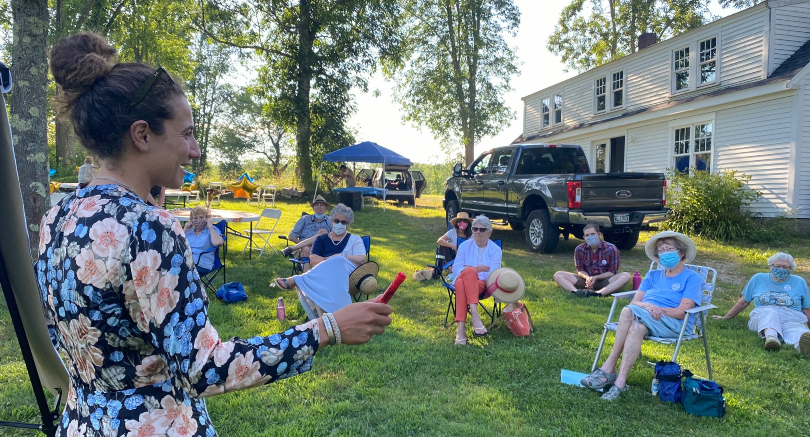
Top photo: Chloe Maxmin campaigning in 2020 | Senator Chloe Maxmin Facebook page

 Daily Updates