

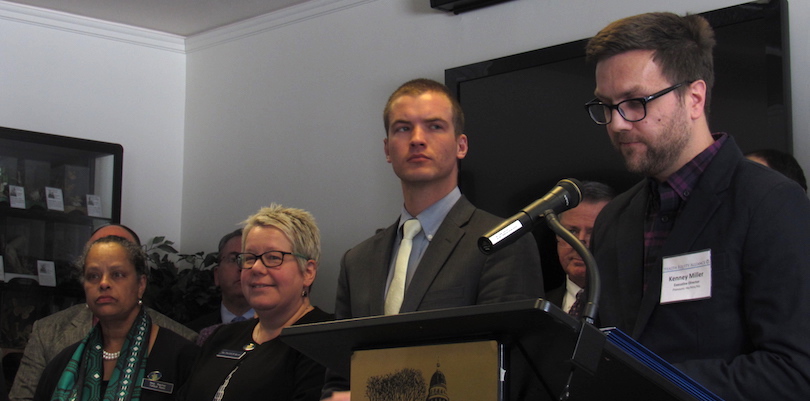
With hundreds of lives already lost to the opioid crisis in recent years, the Maine Coalition for Sensible Drug Policy held a press conference at the State House Thursday calling on the Mills administration and state lawmakers to rewrite the narrative around the epidemic — from one intent on punishing those in the throes of the crisis to one focused on treating the trauma that underpins substance use.
The coalition unveiled its comprehensive 24-page report, bundled with a shorter overview of policy recommendations, that outlines how lawmakers can change the state’s approach to helping Mainers with substance use disorders.
In particular, the impact of adverse childhood experiences (ACEs) on the likelihood a person will develop a substance use disorder is examined at length in the report, highlighting what they see as an unmistakable connection between childhood trauma and later drug use that health care providers say is usually glossed over in policy discussions.
“That’s the area that distinguishes this [report] — the ACEs, the attention to trauma, as the driving force underlying problematic substance use,” said Kenney Miller, executive director of the Maine Health Equity Alliance (HEAL), a health advocacy organization that, along with Maine Family Planning, spearheaded the recommendations. “It’s been talked a lot about in circles, as far as social service providers are concerned, but hasn’t entered policy in much depth.”
With 75 percent of those with a substance use disorder saying they’ve obtained opioids from sources outside the doctor’s office, the report argues that the epidemic can’t be chalked up solely to overprescription.
According to the report, “between 50 and 90 percent of people with a reported substance use disorder also had complex trauma histories.” Deprivation, food insecurity, housing insecurity, “and other conditions intimately related to poverty” can further exacerbate the trauma that is at the heart of substance use disorder.
“To call the current system a campaign of structural violence against marginalized people is not an exaggeration,” said Jesse Harvey, co-founder of Journey House and a person in recovery who spoke at the press conference. ”For although the state does not hold a gun to the head of the drug user, it willingly pays more money for a worse system of care that kills more drug users and ruins more lives.”

Among marginalized communities, historical trauma and oppression “have ramifications that extend to today and into the future,” the report explains. Decriminalizing drug use can help marginalized communities, which are disproportionately targeted by policing efforts, better care for members with substance use disorders.
Rep. Rachel Talbot Ross (D-Portland) provided the historical context for drug policy in Maine and nationally, which has for centuries been driven by anti-immigrant and racial bias.
“Today’s drug laws are rooted in and perpetuate those biases to such an extent that they are applied differently to people of color than to white people,” she said. “While people of color and white people use drugs at similar rates, our punitive laws disproportionately trap people of color, especially Black people.”
According to Talbot Ross, Black people account for 46 percent of drug defendants in Maine, despite only making up 1.6 percent of the population.
Above all, a message of focusing on “compassionate care for people who use drugs” to reduce stigma and encourage recovery was the mainstay of the press conference.
“[The coalition’s recommendations] call on us to treat the problem of drug use as a social problem and a public health issue requiring complex solutions,” said Miller. “They call on us to treat people who use drugs with compassion — to love them into recovery.”
(Top photo: Some of the speakers at the coalition’s press conference. From left to right: Rep. Rachel Talbot Ross, Rep. Charlotte Warren (D-Hallowell), Jesse Harvey, and Kenney Miller. Not pictured: Natasha Irving, district attorney for Maine Prosecutorial District 6; Courtney Allen, a Mainer in long-term recovery; Connie Adler, a physician and member of Maine Family Planning. )

 Daily Updates