

This is part one of a multi-part series. Part 2. Part 3.
Last March, University of Maine System director of government and community relations Samantha Warren stood before the Maine legislature’s Labor Committee and announced that, this year, things were going to be different.
“As returning lawmakers may be aware, the University has historically not weighed in on labor legislation,” she said in testimony during a public hearing. “That has changed this session.”
Over the seven months of the 2019 legislative session, the UMaine system fought, both publicly and through political backchannels, nearly every piece of legislation that sought to strengthen worker rights and protections.
Emails obtained by Beacon through Freedom of Access Act requests shed light on a public university administration that has taken a sharp rightward turn, particularly on labor issues.
The UMaine system is one of Maine’s largest employers, with more than 10,000 employees serving nearly 30,000 students across seven universities. The internal communications of Warren and others show those at the helm of the institution carefully calculating when they should risk taking a public stance against bills, when they could work against legislation behind the scenes and when they could be confident that Governor Janet Mills would prevent a bill from becoming law.
Aside from a statewide paid time-off law, which passed in a weakened form under the threat of a citizen-initiated ballot measure, no major labor bills that system administrators opposed made it past the governor’s desk last legislative session.
“I think it was very disappointing and disturbing to see the UMaine system this year actively oppose basic overtime standards, paid sick days, aggressively opposing strengthening collective bargaining rights,” said Matt Schlobohm, the executive director of the Maine AFL-CIO. “The system obviously had their disagreements with the LePage administration, but in terms of worker rights proposals and basic economic justice issues, they didn’t have anything to worry about. It’s a new landscape that shows their truer colors and where they are going to stand. Essentially, they’re lobbying for a lower-road, lower-wage economy.”
‘We have to stop this on the second floor’

After eight years under former Republican Governor Paul LePage and his veto pen, labor advocates in 2019 felt they had their first chance in a long time to make policy gains for workers. Democrats controlled both chambers of the legislature, its crucial labor and appropriations committees, and the governor’s office.
As the legislative session was getting underway, some progressive lawmakers were hoping to advance bills that would give workers more benefits and bargaining power. On several key policies, legislators had the backing of the state’s major education unions, including those representing university adjunct faculty and public school teachers, both of whose members have experienced years of stagnant wages.
At the same time, the UMaine system administration was planning its strategy to defend against many of these reforms.
The first bill that raised the alarm for the administration was a proposal that would more than double the number of salaried workers in Maine entitled to overtime pay. Soon after state Rep. Ryan Tipping’s (D-Orono) overtime bill was printed, Warren reached out to the Maine State Chamber of Commerce, one of Maine’s most powerful corporate lobbies in Augusta, to make a plan.
“Do you have a few minutes for a call today about a bill I am worried about?” Warren wrote in a Feb. 1 email to chamber vice-president Peter Gore. He responded, “Call me in 5 minutes if you want.”
After that phone call, Warren wrote to her UMaine colleagues including Chancellor James Page and Vice Chancellor for Finance and Administration Ryan Low to formulate a response.
“Last session, we stayed away from engaging on a similar version of this bill, given we knew LePage would veto and the thresholds were much, much lower. This time around, there is a very real danger it could pass given the make-up of the Labor Committee. The State Chamber said they will sue in that case,” she wrote. “Rep. Tipping is very sensitive to not getting sideways with the University on this or other issues. I am going to try and catch him next week to talk this over.”
In an email a few days later, she added, “I will be honest and say given the makeup this session, there is a real chance we have to stop this on the second floor,” referring to the governor’s office, which is on the second floor of the Maine State House. It appears that Warren believed that the best avenue for stopping the increase in overtime was through Mills.
‘Part of a nationwide trend of the corporatization of public higher education’

The UMaine system’s more aggressive positioning on labor issues has been largely steered and represented by figures with conservative backgrounds within the chancellor’s office, some of whom previously held positions in the LePage administration.
Dan Demeritt, a former policy and communications director for LePage, now serves as the system’s voice to the public as executive director of public affairs.
Warren, the system’s voice inside the State House, served as the spokesperson for both the Department of Environmental Protection and the Department of Education under LePage, and after that worked as district director in former Rep. Bruce Poliquin’s congressional office. She joined the UMaine system in 2016, working closely with Chancellor Page, who retired last summer after seven years in that role.
Page was hired by the system’s Board of Trustees in 2012, leaving behind his CEO position at the James W. Sewall Company, an Old Town forestry and natural resources consulting firm. At the time of his appointment, he was credited in the media with bringing a businesslike sensibility to the university system, which was facing a projected five-year $90-million structural budget gap as state funding decreased in the wake of the Great Recession.
In 2015, Page launched the “One University” initiative that merged the operations of the system’s seven campuses to reduce administrative redundancy and cut costs without raising tuition rates.
The initiative eliminated academic programs and included controversial personnel cuts, including tenured professors at the University of Southern Maine. Critics said the “One University” initiative wrongly applied principles of austerity to the college system. At the same time, LePage and Republicans in the legislature were in the process of shrinking the state budget through a series of tax cuts favoring the wealthy.
“I think we really see this whole supposed financial crisis as part of a nationwide trend of the corporatization of public higher education,” former USM student Meaghan LaSala said in 2014. LaSala was among hundreds of students at the time who occupied the USM provost’s office and disrupted board meetings, chanting “Invest in USM,” “Stop the cuts” and carrying signs reading “Reject austerity.”
The UMaine system cut more than 900 positions between 2007 and 2015, saving $82 million in salary and benefits costs each year.
Throughout this, the system was also following a national trend of shifting course loads away from full-time tenured professors and onto lower-paid, part-time adjunct faculty. Nationally, about three-quarters of all faculty positions are off the tenure track. In the UMaine system, adjuncts currently make up an estimated 40 percent of teaching staff, according to the Maine Education Association, up from 36.2 percent in 2009.
Jim McClymer, president of the Associated Faculties of the Universities of Maine (AFUM), the faculty union, said, “They’re more focusing on their short-term interest, which is not in the interest of the people of the state of Maine or the university.”
“I think austerity leads to a large negative outcome, where quality spirals down, access spirals down, and we end up with a cheap, low quality product and you don’t even recognize you’re being cheated out of,” he continued. “This is a societal issue, as public education needs public funding.”
This “downward spiral” in public funding meant that each bill that could potentially increase wages and benefits for university workers was seen by the system as an expense that would be shifted onto students, putting student affordability and workforce investment into direct competition.
‘Just another greedy business trying to exploit its workers’

In early March, as a procession of workforce bills were coming out of the legislature’s Office of the Revisor of Statutes, Warren wrote to her boss suggesting that the time had come to meet with Mills.
“Given all the labor bills and their potential impact on us, I think we’d be well-served to get in with the Governor to hear where she is on these bills generally and convey our concerns about impact,” Warren wrote to Chancellor Page on March 8. “Just yesterday, mandatory paid sick leave (which would apply to part-time and student workers) was voted out of Committee and is expected to be moved on quickly.”
She added, “I worry about us standing up against so many of these bills and the consequences of that, and obviously we’d want to not put ourselves out there if it wasn’t entirely necessary.”
Throughout the month of March, Warren set about organizing a meeting between herself, Page and Mills.
In another email, Page updated the system’s Board of Trustees on Warren’s legislative strategy, which included testifying against several labor bills if deemed necessary. He also discussed taking a publicly neutral position on other measures, such as a bill to increase the minimum wage for large employers, but highlighted what he saw as an opportunity to impress upon lawmakers the system’s concerns over rising labor costs.
“There are a slew of bills before the Labor Committee which, taken individually, are bad enough but taken as a package would be financially disastrous,” Page wrote on March 17 to the board. “These include changes in the minimum wage, paid family leave, changes in the overtime exempt/non-exempt thresholds, and more.”
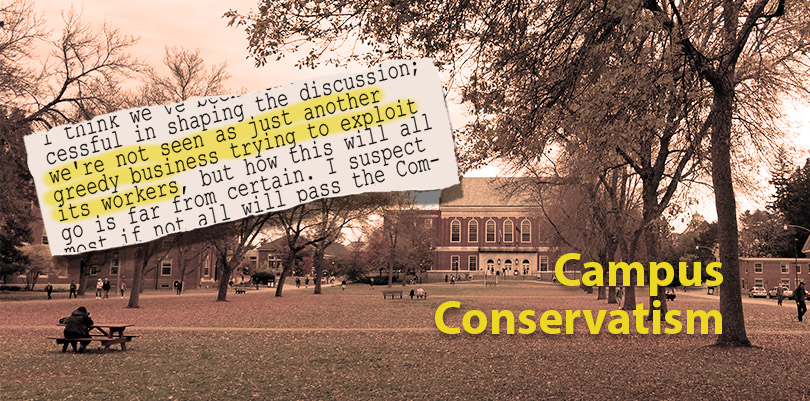
He continued, “We are therefore actively involved in testifying, sometimes in opposition, sometimes neither-for-nor-against but with a clear accounting of the fiscal note, depending on the context and the politics. I think we’ve been somewhat successful in shaping the discussion; we’re not seen as just another greedy business trying to exploit its workers, but how this will all go is far from certain.”
When asked by Beacon what “consequences” Warren feared as a result of this public advocacy against labor legislation, Demeritt, the system’s public affairs executive, didn’t answer directly.
“The System’s Director of Government Relations is expected to provide University leaders with candid advice on how best to preserve the standing and political capital of the University of Maine System,” wrote Demeritt in an emailed response. “Informed by this advice and Board policy 214 the System declined to take a position on many labor issues and worked with bill sponsors to improve or pass other proposals.”
UMaine rejected offer from lawmaker wanting to fund staff overtime
One of the most striking examples of the university administration placing its thumb on the scale to thwart legislation that would have directly benefited its employees was their lobbying against the expansion of overtime pay.
In this instance, not only were they refusing an offer to increase funding to cover the proposed changes in overtime, but they intended to tell lawmakers that it would be “not reasonable” to expect it or ask for it.
Ahead of the March 11 public hearing on Tipping’s overtime bill, Warren arranged to meet with the lawmaker and warned that the additional labor costs would likely be shifted to student tuition unless the UMaine system could secure more funding from the legislature.
Tipping’s bill would raise the number of salaried workers in Maine who are eligible for overtime protection from 26,000 to 54,000 — or from 20 percent of the state’s salaried workforce to 42 percent. It would do so by lifting the salary threshold under which workers are automatically entitled to overtime from $33,000 annually to $55,000. It sought to lock in at the state level the threshold proposed by the Obama administration, which has since been rolled back by President Donald Trump’s Department of Labor.
Faculty positions in the UMaine system would not be affected by the proposal, as they are exempt for being labelled high-earning “professional” jobs. But the system’s human resources department estimates that 945 non-faculty salaried employees, including IT, administrative, and coordinator positions, would fall under the $55,000 threshold.
“Depending on the numbers we may be in a position where NFNA [testifying ‘neither for nor against’ during the public hearing] is a good public response while we’d push the cost impact behind the scenes to work against or lessen the impact of such a bill,” the chancellor’s chief of staff and UMaine counsel Jim Thelen advised Warren.
On Feb. 21, Warren met with Tipping about mitigating the impacts of his bill on the UMaine system. Tipping didn’t want to raise student tuition costs and he knew from the outset that additional state funding would be needed to cover state workers and university employees, many of whom live in his Orono district. He offered to attach a fiscal note that would ask the Appropriations Committee to increase funds for the system to cover the eligible overtime pay.
Warren declined the offer. “I spoke to the Chancellor and Ryan Low about your generous proposal to mitigate the impact to our public postsecondary institutions and I think there is a serious concern that if this approach was successful, our appropriation in the Governor’s budget would be in-turn reduced by this amount,” she wrote.
A day before the public hearing, Warren sent Tipping her prepared remarks and said that the university system would publicly oppose the legislation.
“I wanted to send along the testimony I will be presenting tomorrow on the overtime bill,” she wrote. “We appreciate all you do for the University and feel somewhat uncomfortable taking this position, though I hope me delivering the testimony instead of the Chancellor helps to temper our position somewhat.”
Tipping wrote back, struck by the fact that, in addition to changing its position from neutral to outright opposed, the UMaine system was also planning to say in their testimony that they were against the idea of asking for additional funds from lawmakers.
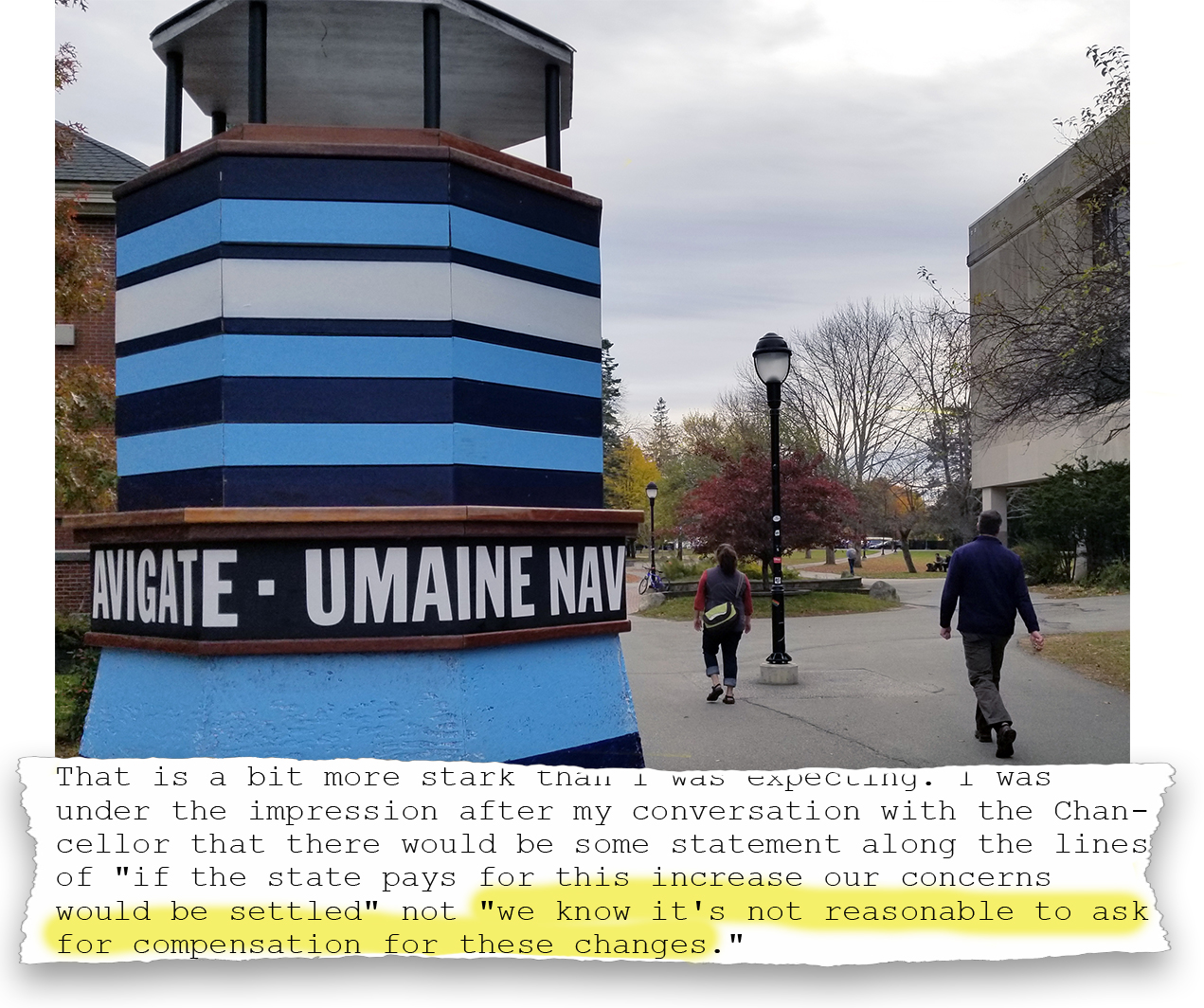
“I appreciate the heads up,” Tipping wrote. “That is a bit more stark than I was expecting. I was under the impression after my conversation with the Chancellor that there would be some statement along the lines of ‘if the state pays for this increase our concerns would be settled’ not ‘we know it’s not reasonable to ask for compensation for these changes.’”
Warren forwarded his response to Page. “Hmm. I told Ryan [Tipping] that that would be our reaction if asked, not that we’d volunteer it,” he wrote.
Warren ultimately struck the line about it being “not reasonable to expect additive State appropriation” from her testimony before the Labor Committee.
In the multiple testimonies that Warren gave before the Appropriations Committee, she never requested additional specific funds so that the university could increase overtime pay for the 945 lowest-paid employees who would qualify under the bill.
James Myall, a policy analyst with the Maine Center for Economic Policy, who consulted with Tipping on the overtime bill, said, “They tend to oppose anything that is going to increase costs for them on paper without really thinking about the impacts on their staff or student working conditions.”
“Frankly,” Myall continued, “one of the reasons why they would be well impacted by the overtime bill is because their staff salaries were so low because they hadn’t had raises in a long time.” He added, “It feels to me that they’d be better off making the argument for more appropriations, instead of buying into the austerity mindset.”
The overtime expansion, which was held over by the Labor Committee until the 2020 session, faces strong opposition from many businesses and the state’s major corporate lobby groups, including the state Chamber of Commerce, the Retail Association of Maine, Hospitality Maine as well as the Maine Hospital Association.
Providing Mills political cover to oppose legislation
Warren’s correspondence suggest that she thought the university system’s legislative efforts would be politically beneficial for the governor, in that they would provide Mills “cover” to take unpopular stances on worker-friendly bills.
After a meeting between Warren, Chancellor Page, and Mills was set for April 1, she sent her boss an overview of the conversation agenda. “In prep for the meeting with the Governor, I sketched out the attached. I’ve listed the bills in order from most concerning to least bad, and then tacked on two that have only just come out and we don’t yet know the impact of.”
In the attachment, Warren listed out the bills in the following order: binding arbitration, teachers’ right-to-strike, a higher overtime threshold, a higher minimum wage for large employers, earned paid sick days, a “fair workweek” mandate, and paid family and medical leave.
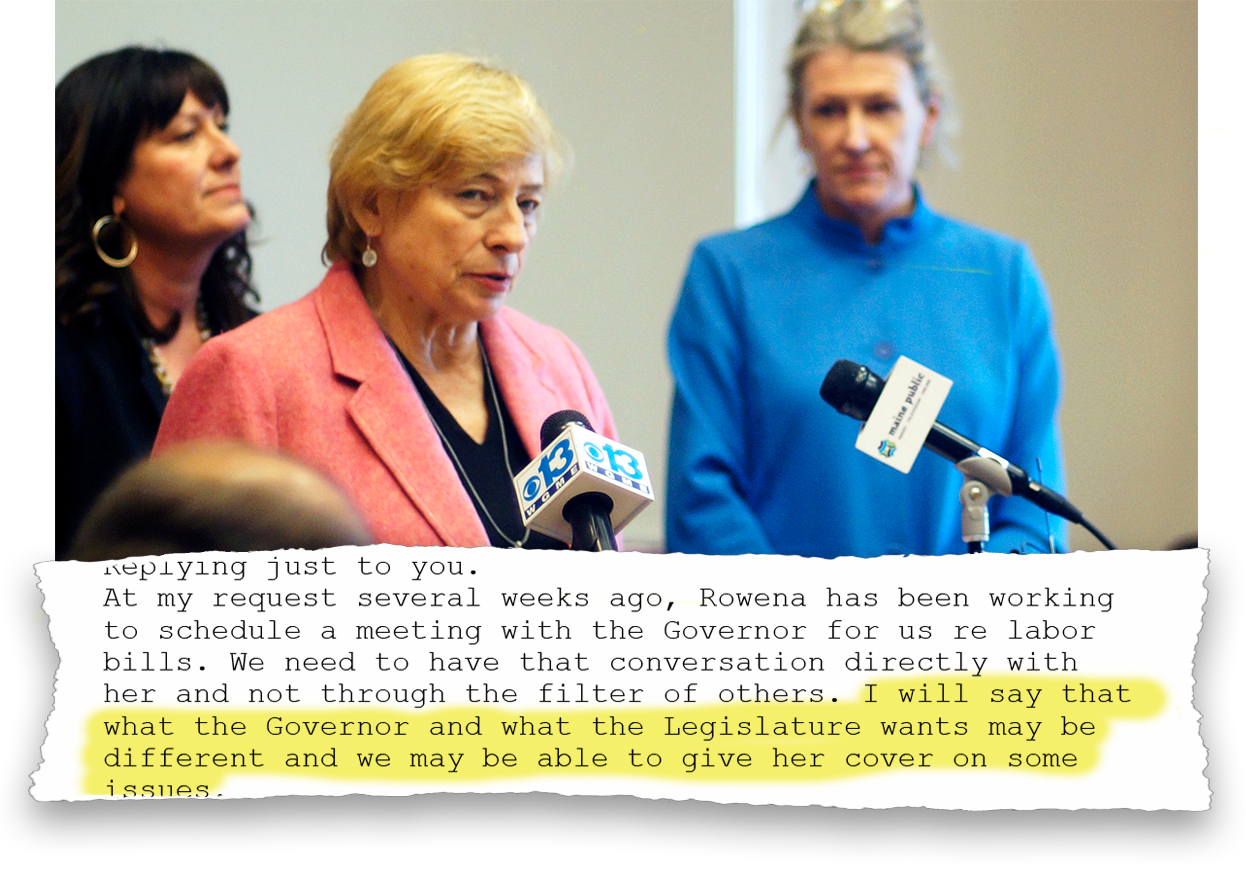
“We need to have that conversation directly with her and not through the filter of others,” Warren wrote to Thelen.
“I will say that what the Governor and what the Legislature wants may be different and we may be able to give her cover on some issues,” she continued, suggesting that the system’s fiscal concerns about the pending pro-labor legislation may be able to provide Mills with a justification to oppose them.
Thelen responded, “Ryan [Low] and the Chancellor and I discussed this briefly this morning too,” referring to the list of bills. “I assumed behind-the-scenes cover would be explored.”
Ultimately, all of the policies on the UMaine system’s list of concerns, aside from earned paid time-off, were either deferred until next year by Democrats or vetoed by the governor.
Among those killed by Mills was the binding arbitration bill, which would have given more bargaining power to public-sector unions by making disputes over wages, retirement and healthcare bound to any settlements brokered by a third-party arbitrator. Both AFUM and the adjunct union, the Part-time Faculty Association, fought for the bill. Adjuncts said binding arbitration was key to negotiating for sustained wage growth after years of failing to get increases incorporated into contract agreements.
“I am really disappointed that the university lobbied against, and the governor vetoed, binding arbitration,” McClymer said. “They don’t want a fair process that will result in higher salaries and fairer procedures.”
“Adjuncts are terribly underpaid. They really don’t want to give benefits to them. They don’t consider them their employees,” said Sherry Leiwant, a co-founder of the legal advocacy group A Better Balance, which works on workforce legislation around the county. “More and more, colleges and universities rely on adjunct professors to teach their courses. That’s their business model. That’s one of the reasons they want to organize.”
Another bill on Warren’s list, the right to strike, the governor told Maine AFL-CIO members she would veto if it reached her desk. That bill, along with a higher overtime threshold and paid family and medical leave, have been carried over to the next session.
Mills did sign the paid time-off policy into law in May, however, not without input from the UMaine system and the state Chamber of Commerce.
In the next installment of the three-part investigation into the University of Maine System’s rightward turn, Beacon will report on the university system’s lobbying to exempt their student workers from earning paid days off.
Disclosure: State Rep. Ryan Tipping is the brother of Mike Tipping, communication director of the Maine People’s Alliance, of which Beacon is a project.

 Daily Updates