

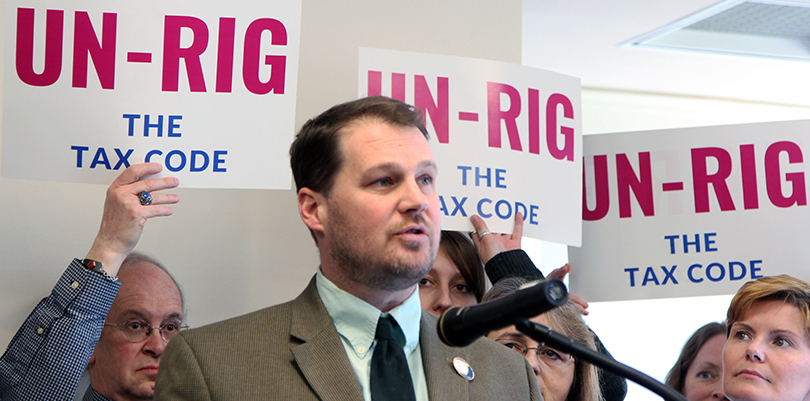
State Rep. Ben Collings of Portland wants to repeal the LePage era tax cuts for Maine’s most wealthy households by taxing estates worth more than $2 million.
Former Governor Paul LePage and Republican lawmakers raised the estate tax threshold from $1 million to $5.6 million for individuals, or $11.2 million for married couples.
Since winning majorities in both the Maine House and Senate, along with winning the governor’s office, Democrats have for the most part left intact LePage’s legacy of cuts.
Calling on Democrats
To pressure his caucus into action, Collings is enlisting Mainers to call on their representatives to take a bold stance on tax fairness and fund critical needs like healthcare, schools, social services and infrastructure.
“Please talk to your legislatures, to the governor’s office, everyone you know. We need money in the state of Maine for so many unfilled needs,” he said at a press conference at the Maine State House on Thursday, introducing his bill, LD 420. Collings was joined by a coalition of supporters from a range of backgrounds — including policy experts, union members, and both wealthy and low-income Mainers.
“There is no such thing as a tax cut. It’s a tax shift. People are getting squeezed,” he said. “When we don’t have enough case workers, when schools are still underfunded, this is one of the fairest taxes to ensure everyone is on an equal playing field. And for wealthy people, especially those that inherited massive amounts of wealth that they did not earn, that needs to go back into society.”
Lowering the threshold to $2 million would raise about $14 million in new revenue for the state and affect about 95 households in Maine, according to an estimate by the Maine Center for Economic Policy (MECEP). That stream of revenue could help pay for some of the policy priorities left unfunded after last session’s budget-making process.
Popular bills, such as one to extend dental coverage to low-income Mainers who are enrolled in MaineCare, passed both chambers of the legislature last year only to die on the Appropriations table. That policy has been reintroduced this session with a swell of grassroots support behind it.
Last year, Democrats failed to fully fund the state’s 55-percent commitment to Maine’s K-12 schools, and its 5-percent commitment to municipal revenue sharing, both policy mechanisms meant to shift funding dependance away from regressive property taxes.
‘The inequality of our day is policy-driven. We designed it.’

Marcus Hutchins, a MECEP board member, economist and former hedge fund manager with Merrill Lynch, said wealthy people like himself need to contribute more to meet these commitments.
“In my youth, economists measured our nation’s inequality and, seeing it as inappropriately high, proposed a number of remedies. Today, a half-century later, we economists look back on the 1960’s as a golden era of relative equality. That is how far our nation has fallen. What was once viewed as unacceptable is now viewed as golden,” he said at the press conference.
He stressed, “And to be sure, the inequality of today is not the natural evolution of progress, or capitalism, or globalization, or providence. It is the natural outcome of our tax, wage, and spending policies. To repeat, the inequality of our day is policy-driven. We designed it. But we can also return to better times through better policies.”
According to a MECEP report released earlier this week, 60 percent of all household wealth in the U.S. is inherited.
Carol Sanborn, a paralegal and president of Local S89 of the International Association of Machinists and Aerospace Workers, said Maine’s working families are not only seeing stagnant wages, but decades of regressive federal and state tax policy has left them paying a bigger portion of the tax burden.
“We’ve watched as nearly all the income gains since the Great Recession have gone to the top one percent,” she said. “As a result of this misguided policy, state and local governments have been starved of badly needed revenue to pay for schools, road repairs, emergency services — services for the most vulnerable among us and investments to support working families.”
Collings’ bill was introduced in the Legislature’s Tax Committee on Thursday where it will be considered by lawmakers.
Top photo. State Rep. Ben Collings (D-Portland) introduces LD 420 at the Maine State House on Thursday. | Dan Neumann, Beacon

 Daily Updates