

Lawmakers and advocates who have been trying to help out-of-work Mainers access unemployment insurance during the COVID-19 pandemic say that the added strain on the state’s benefit system has exposed systemic neglect and dysfunction years in the making.
On Wednesday, lawmakers on the state legislature’s Labor and Housing Committee were briefed by Department of Labor Commissioner Laura Fortman by video on the current backlog. Committee members asked Fortman what the department needed in order to ensure that the rush of new applicants can be processed as quickly as possible.
“We want to hear a concrete plan,” Labor Committee House chair Rep. Mike Sylvester (D-Portland) told Beacon prior to the hearing. “Right now, we don’t care how we compare with other states. What we care about is how Mainers can access the system and get their benefits. My questions to the commissioner will be, what do you need, in very concrete terms, to achieve that?”
A tsunami of applicants

Ahead of the hearing, worker advocates also called on the Mills administration to fix a chronically underfunded and understaffed applicant processing system that can’t handle the current tsunami of applicants.
In March, before the economic effects of the pandemic struck, the state had just 14 employees to process claims, half as many as the department had in 2009.
More than 110,000 Mainers have since filed for employment, more than the total number of claimants over the last three years. More than 70,000 workers have received benefits.
Advocates are also asking the state to modernize its system to reflect the current economy, where increases in part-time, temporary and gig work have resulted in just one in four unemployed workers in Maine receiving unemployment insurance prior to the pandemic.
Federal money recently made available by Congress through an initiative called Pandemic Unemployment Assistance (PUA) attempted to fill some of those eligibility holes, as well as increase benefits. Maine is one of 13 states that began rolling out PUA last week.
“Commissioner Fortman and her staff have done the best they can with the system they inherited, but the real issue is the need for modernization, reform, and adequate funding,” Maine Equal Justice (MEJ), an anti-poverty advocacy group, wrote in a memo sent to lawmakers on Wednesday.
Fortman agreed that state and federal unemployment insurance provisions are out of date.
“It was designed in the 1930s when most people worked full-time for clearly defined employers,” she told the Labor Committee on Wednesday.
She explained that her department has created 138 staff positions to process claims, which they will start filling over the next several weeks.
Will workers lose benefits if they don’t return to return to re-opened businesses?
Committee members also asked how the administration can ensure that workers are not forced into unsafe working environments as a condition of maintaining unemployment benefits.
Labor advocates have warned that in other states that are reopening their economies, employers classify employees who do not immediately return to work, perhaps for concerns about health vulnerabilities, as having “quit,” and thereby deny those workers unemployment insurance.
With Maine as the only state in New England that has so far announced a reopening plan, there is concern that the same pressure could be put on Maine workers.
“Employers are getting ready to dispute claims, because employees are saying, ‘I’m afraid to go back to work because of COVID — I have an immunosuppressed child. I have all of these different issues.’ What should employers and employees do until they get more clarity?” Sylvester asked Fortman during the briefing.
Fortman said that such claims would require an investigation.
“There are protections under PUA for people to refuse to go back to work under certain circumstances,” she explained. “We would talk to the employee and find out why they were concerned. Did their physician tell them to not go to work? Did their employer offer them a telework opportunity that they refused?”
“But the expectation is that if you are offered suitable work, unless there is something that could cause an exemption, that you would go back to work,” she added.
‘Chronically underfunded and understaffed’
Advocates with MEJ, which has been helping Maine workers apply for unemployment insurance, pointed out that going into this crisis, the percent of unemployed workers that actually qualified for unemployment benefits was at an historic low.
Just 26 percent of unemployed workers in the state received benefits in 2019, down from 32 percent during the Great Recession and down further from the recession of the early 1990s when 46 percent of unemployed workers received benefits.
MEJ said that the number of people receiving benefits has fallen because the state economy has changed to include a greater share of service industry jobs and the unemployment system has not evolved along with it. They explained that it is harder for today’s low-wage workers facing irregular work schedules and inadequate pay to meet the system’s qualifying requirements.
“The labor market has undergone several seismic shifts since the UI program was created more than eight decades ago, including major declines in the share of employment in manufacturing, full time work as a share of all work, and large increases in the services sector, part-time and temporary work. But Congress has ignored the need for UI reform and modernization, and the program has been chronically underfunded and understaffed,” MEJ wrote in its memo.
The group is calling on state lawmakers and the administration to require the Department of Labor to analyze and improve its unemployment insurance recipiency rate, ensuring that workers previously shut out of the system can access needed benefits.
Robyn Merrill, MEJ executive director, also noted that the exclusively online application system implemented in 2018 is not intuitive for all users, and some applicants have had difficulty filing and need assistance from a human being that they could not easily reach.
Nationally, disqualifications for procedural reasons have nearly doubled over the past five years as states move to online claim-filing, according to a study by the National Employment Law Project.
“The fact that Maine’s unemployment insurance (UI) system has been unable to meet the needs of many Mainers who have lost their jobs or been forced to stay out of the workforce due to COVID-19 is deeply unfortunate, but not surprising,” Merrill said in a statement. “At Maine Equal Justice, we have worked with too many people over the last several weeks whose claims have been delayed because of technicalities, who are waiting long and stressful weeks for their UI checks to arrive, or who simply do not qualify and are excluded from help. These Mainers have lost income through no fault of their own.”
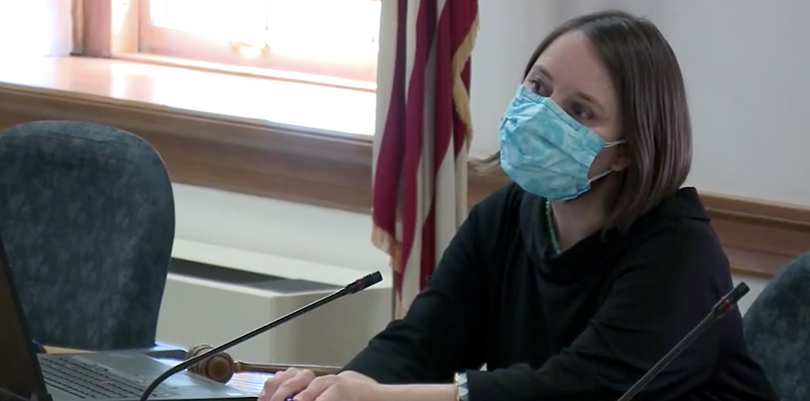
Top photo: The Labor Committee’s Senate chair, Shenna Bellows (D-Manchester), listens to Commissioner Laura Fortman’s briefing on Wednesday. | WCSH video stream

 Daily Updates