

 The U.S. House of Representatives has set a vote for Friday, June 26 to finally grant statehood to the District of Columbia. This will be the first time since 1993 since either chamber of Congress has taken up the issue. With 226 co-sponsors, the bill is all but guaranteed to pass.
I’m glad to see my representative, Chellie Pingree, is one of those co-sponsors. The bill is dead on arrival this year in the U.S. Senate, where Mitch McConnell has described equal voting rights for D.C. residents as “full-bore socialism.” But if Democrats achieve 50 seats in the U.S. Senate in this November’s election, and Joe Biden’s current 9-point lead in national polls holds up, D.C. statehood is a real possibility in 2021. It’s about time.
Maine was admitted as a state in 1820, 32 years after the ratification of the U.S. Constitution. By way of comparison, D.C. became the nation’s capital in 1800 — 220 years ago. When Maine was admitted to the U.S., it had just shy of 300,000 residents. D.C. today has 705,000, more than either Wyoming or Vermont.
Because D.C. isn’t a state, the Trump administration, apparently on command of Attorney General Bill Barr, was free to order peaceful protestors to be pepper-sprayed and tear-gassed to set up a photo-op where President Trump could hold a bible in front of a church. Also because D.C. isn’t a state, it got stiffed on COVID-19 funding. D.C. was allocated $500 million to care for 705,000 people, well short of the $1.25 billion minimum that all 50 states got. So D.C. received $709 per resident, and Wyoming received $2,160 per resident. D.C. has had 533 deaths. Wyoming? 20.
In Maine, Black residents account for 1.4 percent of the population, but 23.6 percent of COVID-19 infections. D.C. has also seen a large racial disparity, with Black residents accounting for 74 percent of deaths but 46 percent of the population. But in Maine, we have received far more funding to try and stop infections and care for those who are ill. That’s no accident. We have two senators and voting representation in Congress- —D.C. doesn’t. That representation translates to funding and having someone looking out for our interests. When D.C. residents want to weigh in on issues affecting them, like the fact that D.C. has one of the highest child poverty rates in the U.S. (23.1 percent vs. Maine’s 14.5 percent), they have no senators or voting member of Congress.
The process for admitting D.C. as a state is a simple one. D.C. has already held their referendum (86 percent favored statehood). The other step is to pass federal legislation. The House is poised to do this on Friday. If they do it again next year and the Senate follows suit, then the president would sign the bill making D.C. a state. Needless to say, President Trump will not do so. He told The New York Post he opposed statehood because most people in D.C. vote Democratic, and he continued that Republicans would be “very, very stupid” to support democracy for the Americans who live there. During his campaign for president, he had said the opposite, claiming, “I would like to do whatever is good for the District of Columbia because I love the people.”
So where are Maine’s senators on this issue? It’s pretty easy to know where Susan Collins is these days. She’s wherever Donald Trump is, with some hand-wringing prior to rubber-stamping anything Donald Trump wants. So of course she isn’t one of the 40 senators sponsoring the D.C. statehood bill. But why isn’t Angus King on there? He put out a strong video advocating for racial justice on Juneteenth. As D.C.’s mayor, Muriel Bowser, wrote last week “…the fight for statehood cannot be separated from the fight for racial justice. It is no coincidence that Washington— affectionately known as Chocolate City — is also the only capital of a democratic nation that denies its residents a vote in the federal legislature. To think these two truths are not related is to be willfully ignorant of our nation’s history.”
There are only three Black U.S. senators. As recently as 2012, there were none, even though the U.S. is 13 percent Black. D.C. has a larger Black share of the population than any state. D.C. statehood wouldn’t make the senate representative of the U.S., but it could make it look just a little more like the country.
In the year that Maine celebrates its 200th anniversary as a state, it would be fitting that Maine’s delegation make America more perfect by including the 705,000 Americans in D.C. in our democracy. Chellie Pingree clearly gets this. Susan Collins clearly doesn’t. Let’s hope Angus King’s action matches his words and he steps up for voting rights and equality.
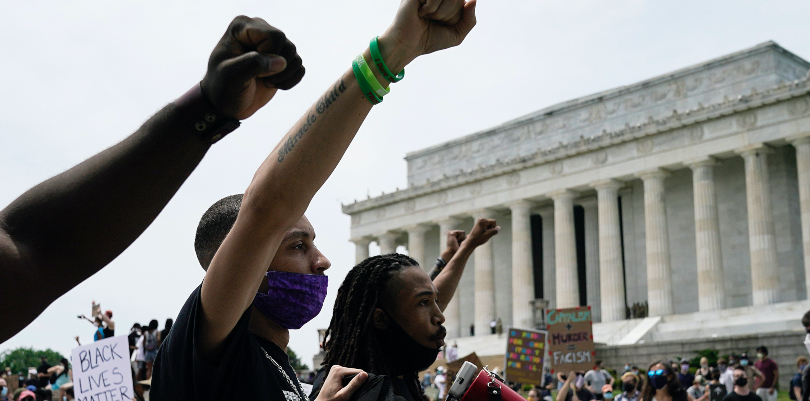
Photo: A Black Lives Matter protest at the nation’s capital. | Drew Angerger, Getty

 Daily Updates