

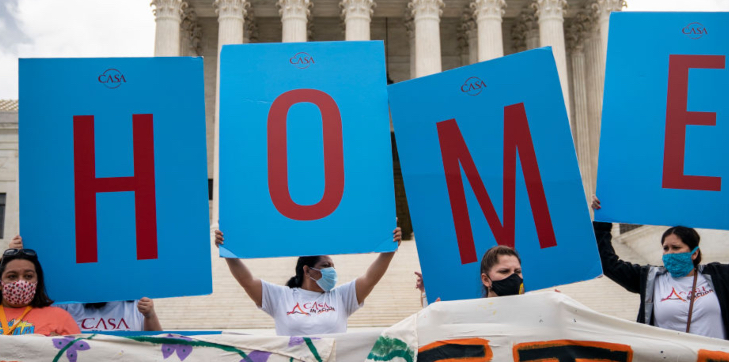
The U.S. Supreme Court on Thursday salvaged an Obama-era program that has allowed hundreds of thousands of young, unauthorized immigrants known as “Dreamers” to remain in the country without immediate fear of deportation.
The Portland-based Immigrant Legal Advocacy Project had estimated that up to 300 immigrants living in Maine faced deportation if the Supreme Court terminated the program.
In a 5-4 decision, Chief Justice John Roberts sided with the court’s liberal wing in finding that the Trump administration broke the law in 2017 when it rescinded the program, known as Deferred Action for Childhood Arrivals, or DACA. Justices Clarence Thomas, Samuel Alito, Neil Gorscuh and Brett Kavanaugh dissented.
Pressure on Senate to pass Dream and Promise Act
Members of Maine’s congressional delegation celebrated the ruling and advocated for Congress to enshrine this protection into law.
“Today’s DACA ruling is welcome news – but there is still work to be done,” Sen. Angus King wrote on Twitter. Congress should pass legislation to take Dreamers who arrived in this country as children out of limbo, so these Americans can continue making key contributions to their communities and country,” as King wrote on Twitter.
Rep. Chellie Pingree highlighted the House-passed “American Dream and Promise Act,” which would also offer a pathway to citizenship for immigrants with temporary protections, known as Temporary Protected Status (TPS) and Deferred Enforced Departure (DED).
“Today SCOTUS reaffirmed that #HomeIsHere,” Pingree tweeted. “Dreamers deserve to live and work in the only country they’ve ever known. Next [Senate Majority Leader Mitchel McConnell] needs to pass the Dream and Promise Act to codify this DACA decision. For those keeping track: The House passed it a year ago! #TBT”
Sen. Susan Collins also praised the ruling, telling reporters, “I have long supported a path to citizenship for Dreamers…Now that the Court has ruled, Congress should take up legislation like the Dream Act so that these young people can stop living in fear.”
However, critics pointed out that not only did Collins vote against the DREAM Act in 2010, but her vocal support of both Justices Gorsuch and Kavanaugh had put Dreamers’ freedom in jeopardy.
“Susan Collins cannot rightly take pride in Maine’s culture of refuge and hospitality while confirming anti-immigration judges who would deny the rights of Dreamers to live in and contribute to the country they know and love,” said NextGen Maine State Director Julian Snow. “Young voters know that Susan Collins doesn’t share our values, and in November, we are going to show her the door and elect a senator who will finally stand up to the GOP’s racism and xenophobia.”
‘Arbitrary and capricious’
Roberts wrote the majority opinion and was joined by Justices Ruth Bader Ginsburg, Elena Kagan, Stephen Breyer and Sonia Sotomayor.
The court held that the U.S. Department of Homeland Security’s decision to end the program was “arbitrary and capricious” and therefore in violation of the Administrative Procedure Act.
“We do not decide whether DACA or its rescission are sound policies,” Roberts wrote. “‘The wisdom’ of those decisions ‘is none of our concern.’
But the department, he said, “failed to consider the conspicuous issues of whether to retain forbearance and what if anything to do about the hardship to DACA recipients. That dual failure raises doubts about whether the agency appreciated the scope of its discretion or exercised that discretion in a reasonable manner.”
Justice Clarence Thomas called the ruling “mystifying” in a dissenting opinion. “Today’s decision must be recognized for what it is: an effort to avoid a politically controversial but legally correct decision,” he wrote.
A ‘ray of sunshine’ in 2020
The ruling will likely inflame partisan tensions ahead of the 2020 presidential contest. It comes days after the court issued an unexpected ruling protecting LGBTQ workers from job discrimination.
Senate Minority Leader Chuck Schumer (D-N.Y.) called the pair of rulings “a bright ray of sunshine” during difficult times. “This is a wonderful, wonderful day,” he said in a statement.
The DACA program was created in 2012 to allow certain immigrants who arrived in the United States before age 16 to apply for temporary protection from deportation and work permits.
About 700,000 people have participated in the program, according to the court. A 2017 survey of DACA recipients found that nearly all respondents were either employed or in school, according to the Center for American Progress.
President Donald Trump vowed on the campaign trail to “end” the program. His administration made good on his promise in 2017, but lower courts blocked the decision from taking effect.
The administration could try to end the program again, the court noted. If it does, it will have to do so in a way that complies with federal law governing such decisions.
Photo: DACA recipients and their supporters rally outside the U.S. Supreme Court on June 18, 2020 in Washington, DC. | Drew Angerer, Getty Images

 Daily Updates