

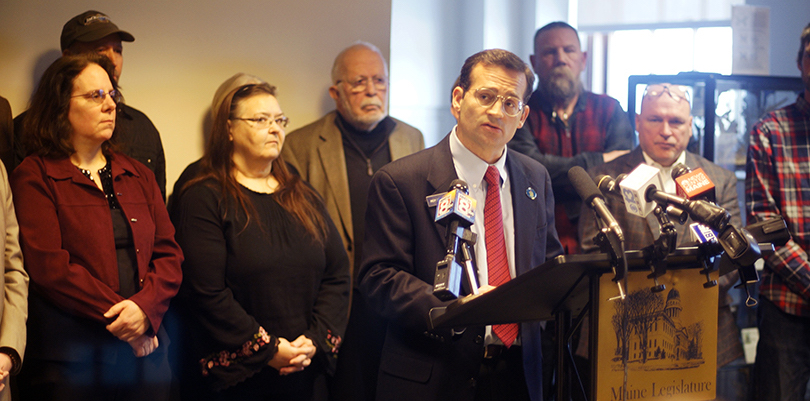
State Rep. Seth Berry (D-Bowdoinham) announced Monday that he is sponsoring legislation to buy out the state’s two main private power providers, Central Maine Power and Emera Maine, and replace them with a consumer-owned utility he argues will be cheaper, more reliable and more responsive to the state’s need for green energy in the face of climate change.
Berry, House chair of the Committee on Energy Utilities and Technology, criticized CMP earlier this month after the Maine Public Utilities Commission announced an investigation into more than 100,000 billing errors by the private utility.
“Both the outages and hundreds of thousands of billing errors have been an absolute train wreck,” Berry said. “We have some of the highest rates in the country. And the reliability, which is the other thing we ask of our utilities, is not among the worst, but literally the worst in the country.”
Berry stressed that bipartisan buy-in will be essential to passing the legislation and cited other jurisdictions, including some areas of Maine, where consumer-owned utilities have already lowered prices and increased reliability.
State Sen. Marianne Moore is a Republican representing rural Washington County and a customer of Eastern Maine Electric Cooperative. “In my humble opinion, a similar consumer-owned power company might be very beneficial to the rest of Maine, given the state’s challenges with costs and reliability,” she said in a statement.
As of 2017, Maine had the least reliable service in the country overall yet among the highest delivery rates.
At the Maine State House on Monday, Berry announced the legislation alongside members of a group called CMP Ratepayers Unite, which is made up of ratepayers, labor and business leaders, community organizations and other legislators.
“My story began when I opened a bill for $653,” said Kristy Pottle, who started the group’s Facebook page, which now has over 7,000 followers. “It’s become very clear that CMP is not accountable to ratepayers, just to their own excessive profits.”
The plan would create the Maine Power Delivery Authority and establish a nine-member bipartisan administrative board, representing different ratepayer classes, including residential, small business and media and large commercial payers. The board members would be appointed by the governor and approved by the legislature, similar to the quasi-governmental boards appointed to administer the Maine Turnpike Authority, Maine Housing Authority and Efficiency Maine.
The board would then sell revenue bonds to raise the capital to purchase CMP and Emera’s power infrastructure at market value, a multi-billion dollar price tag.
The board members’ six-year terms would be staggered, Berry explained, “So no one governor is able to snap their fingers and change it. It’s protected from the political winds.”
Without investors, primary goal is low costs

There are already a few community-based utilities operating in the state. Community members currently elect trustees to manage the Kennebunk Light and Power District, the Eastern Maine Electric Cooperative in Calais, the Houlton Water Company, and the Madison Electric Works — all of which operate under a similar consumer-owned utility model. While those districts would remain independent, Berry’s plan would extend this model of ownership to the rest of the state.
Whereas the corporate boards of CMP and Emera have fiduciary responsibilities to their investors, Maine Power’s “only job would be to keep the lights on and keep the cost low,” Berry said.
Maintaining high investor returns has led CMP — owned by Spanish firm Iberdrola and its subsidiary Avangrid — to cut jobs, which has exacerbated the company’s billing and outage problems, Berry said, and forced it to charge its Maine customers higher rates despite the poor service.
“They’ve really shown an absolute allegiance to their international investors as opposed to their Maine customers and workers every single time,” he said.
By doing away with private investors, the Maine Power Delivery Authority could refinance its power grid assets, which would mean that Mainers currently receiving power through CMP or Emera would see smaller monthly electricity bills, Berry asserts.
“It’s like refinancing a house at a lower interest rate,” Berry explained. “Right now we pay 10-12 percent to CMP’s overseas investors. Instead, we could pay 3 percent or so in interest and keep the difference in our pockets and our local economy.”
“Two different experts have calculated that this would create an immediate 15 percent reduction in electricity rates, which represents approximately $325 million in annual savings to Maine residents and businesses,” he continued. The American Public Power Association puts the average savings for customers of public utilities compared to investor-owned utilities at 15 percent.
Nearly 13 percent of the nation’s meters are customers of electric cooperatives, according to the National Rural Electric Cooperative Association.
Nebraska has been electrified by public power, governed by a 11-member popularly-elected board of directors, since the 1940s. It is the only state with 100-percent consumer-owned power. In 2017, Nebraska led the nation with the most reliable energy grid.
In 1985 the New York state legislature elected to buy out the state’s privately-owned utilities and replace them with the Long Island Power Authority. When the LIPA eventually transitioned to ownership of New York state’s electrical grid in 1998, residents saw a 20-percent reduction in their electricity rates.
Building a utility that can face the climate imperative
Unlike investor-owned power, a statewide, consumer-owned utility would be more responsive to the need to decarbonize the state’s energy grid by moving towards renewable energy, Berry says, as it would be subject to better public control and regulation.
“The utilities, particularly Central Maine Power, have opposed those kinds of solutions at every turn,” Berry said. “And they are the biggest obstacle to Maine having that kind of smart utility of the future, which is greener and more responsive to the climate imperative.”
Berry, echoing climate and energy experts, says that a greener utility for Maine will involve moving as much energy consumption as possible to the electrical grid. That means encouraging more and more Mainers to stop using technologies that run on combustion, such as cars and natural gas heating and cooling, and move to alternatives that run on electricity, such as electric vehicles and heat pumps.
The idea is that if the state can reduce the carbon powering the electrical grid, through diversified renewable energy inputs such as rooftop solar, then all the technology that draws off that electric supply will be cleaner.
“The demand on the grid will approximately triple when we add heating, cooling and electric vehicles,” Berry said. “The amount of money that would be pouring out of our state to send to overseas investors in Spain, Qatar, Norway would increase, as well as the unaffordability of the power for many, especially lower-income individuals.”
“If we want to make electrification of transportation and building heating and cooling happen, we need it to be affordable and within reach of the consumer,” said Berry.
The CMP and Emera buyout legislation will go to the Energy Utilities and Technology Committee, which Berry co-chairs with state Sen. Mark Lawrence (D-York). The committee will hold public hearings on the proposal before the measure is considered by the full legislature.
(Top photo: State Rep. Seth Berry speaking at a press conference Monday at the Maine State House announcing the legislation that would create Maine Power Delivery Authority. | Dan Neumann)

 Daily Updates