

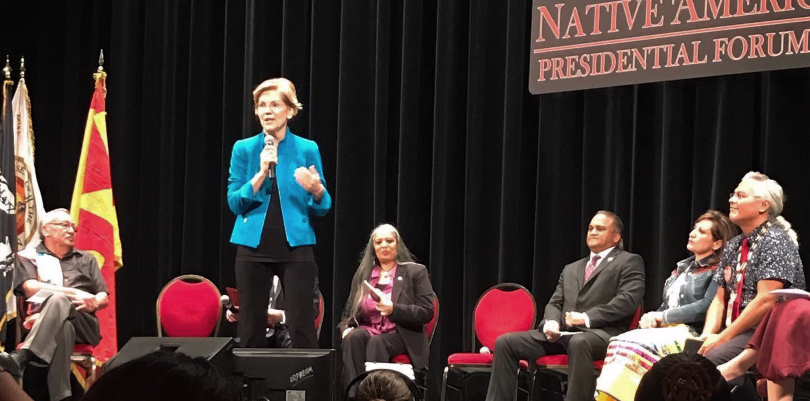
 In my capacity as Penobscot Nation Tribal Ambassador, I had the honor and privilege of attending the first ever Frank LeMere Forum for Presidential Candidates on Native American Issues held in Sioux City, Iowa on Aug. 19 and 20.
Invitations were sent to all those running for U.S. President and the following candidates presented either in person or remotely: Marianne Williamson, Sen. Elizabeth Warren, Sen. Amy Klobuchar, Montana Governor Steve Bullock, Mark Charles (Dine Nation Tribal Citizen running as an independent), Sen. Kamala Harris, former Congressman John Delaney, former Housing and Urban Development Secretary Julian Castro, Mayor of New York Bill de Blasio, and Sen. Bernie Sanders. All the candidates who presented are running for the Democratic nomination except for Mr. Charles.
The event was hosted by Four Directions and Native Organizers Alliance with many co-hosts including local tribes, the National Congress of American Indians, and United Southern and Eastern Tribes.
Each candidate was introduced by a person of interest and notably Congresswoman and Tribal Citizen Deb Haaland introduced Warren with a lengthy and spirited endorsement.
Native issues, policies and the big fight ahead
During the discussions, tribal leaders asked the candidates questions pertaining to issues facing tribal nations, including legislation to address Missing and Murdered Indigenous Women, environmental protections, the rights of tribes as sovereign nations, healthcare, and the Remove the Stain Act, which would rescind Medals of Honor for soldiers that murdered innocent Lakota people at Wounded Knee.
There was a recognition throughout the gathering that while Medicare for All is a good policy, it is not the answer to the discrepancies that persist in health care for Native nations. Indian Health Services and the issues we face are often separate from most conversations regarding health care.
Over the course of the whole event, one significant theme was how do we fight back against the racist agenda of Donald Trump and his followers and vote him out in 2020. It was repeatedly stressed that, although we are a small voting bloc, our votes can make a significant difference in some key battleground states.
Addressing past mistakes
I had the honor of sitting on a panel as a tribal leader to talk about the harm of Indian mascots and was proud to announce that Maine had banned them in our public schools. I then asked Mayor de Blasio if he would ban them as president, to which he replied he would.
On the issue of sovereignty, all of the candidates that attended were on the same page about the need to protect sovereignty and treaty rights. While some revealed a gap in understanding these issues, they were eager to learn.
At one point, Sen. Klobuchar was heckled for her lack of action in Minnesota regarding the Line 3 oil pipeline construction, which tribal groups oppose for environmental reasons.
Sen. Warren gave an apology for her part in the DNA test/claim to Cherokee ancestry situation and it went over smoothly. As an aside, I thought it would have been a good opportunity to highlight Trump’s problematic use of “Pocahontas” as a racial slur.
We are still here and we have a voice
As a dedicated Democrat and follower of all things politics, the event thrilled my inner political science nerd. As a Penobscot/Indigenous woman, I found myself feeling something much deeper. The opening ceremony with drumming and smudging and prayers in Native languages sent a resounding message that we are still here.
This is a message that I say a lot in my work and activism and to feel it in a palpable way through the energy of all the Nations represented moved me to tears a few times.
We are a people displaced, colonized, stripped of land, resources, culture, forced to watch the “conquerors” add insult to injury over the generations by outlawing our sacred religious practices and ceremonies while at the same time stealing them for sports mascots and Hollywood movies.
Yet here we stood, ready to make our voices heard with the firm promise that we would be using those voices at the voting booth.
Indigenous people did not have the right to vote in our homeland while our people were fighting wars for this country until 1954. Even later were we granted that right in Maine. It is not something I will ever take for granted and I know that I stand on the shoulders of those before me who had no voice or visibility.
Sen. Elizabeth Warren speaking at the Frank LeMere Forum for Presidential Candidates on Native American Issues. (Photo: Maulian Dana)

 Daily Updates