

After numerous states where elections were held last week saw massive lines at the polls, delays in reporting results and other logjams, advocates in Maine are asking the state to take additional precautions to protect Maine voters’ access in the July 14 primary.
A surge in vote-by-mail ballots caused delays in Indiana, New Mexico and Pennsylvania while widespread reductions in in-person polling locations caused hours-long waits to vote.
Last week, Governor Janet Mills issued an executive order extending the deadlines to receive absentee ballots and submit voter registration applications by mail or through a third-person.
But a local coalition of pro-democracy groups is concerned those steps do not go far enough to make voting accessible to all Mainers. They have been calling on Mills and Secretary of State Matt Dunlap to “maintain robust in-person voting to the maximum extent possible while considering public health so that all eligible Mainers can exercise their right to vote however is safest and most accessible for them,” the group wrote in a press release in response to the executive order.
In addition, the coalition is asking the state to provide online options to assist voter registration, mail absentee voting materials to every eligible voter, notify voters if their ballot has been rejected and allow them to remedy the mistake.
Encouraging absentee voting ‘as much as possible,’ though certain technologies required
During a press conference on Monday, Mills was asked what the state is doing to protect against voting issues as were seen across the country last week.
The governor pointed to the executive order and said they are encouraging Mainers to utilize absentee voting options.
“The history of a primary like this is usually kind of low turnout, but we’re hoping people will turn out and vote absentee,” Mills said. “There’s a U.S. Senate primary, there’s a U.S. Congress primary, and some 30 other primaries going on, plus the bond issues, plus local school budgets and other local issues. So, we want people to come out and vote but preserving the right to voting in-person but minimizing by […] encouraging absentee ballot requests as much as possible or as early as possible.”
Currently, Maine residents can register by picking up voter registration cards at their town office, BMV branch offices, most state and federal social service agencies, or at voter registration drives. On May 5, Dunlap announced that Maine residents can also now print out the voter registration application and mail it in to their town clerk. An absentee ballot can be requested by calling or visiting one’s municipal clerk or by filling out an online form, though a valid street address and email are required.
According to recent numbers released by the secretary of state’s office on June 3, more than 38,000 Maine voters had requested absentee ballots for the July 14 primary, which is triple the number of requests made for the June 2016 primary.
But advocates are concerned that the needs of those who don’t have access to certain technologies are not being considered.
“We’re glad deadlines have been extended to give people more time to register and vote by mail, and that the Secretary of State created an online ballot request form. But we would like to see more, like an equally easy way for people to register to vote that doesn’t require owning a printer or visiting a municipal office. That is one change that would make a huge impact,” said Zachary Heiden, legal director of the ACLU of Maine, which signed on to letters to the governor and secretary of state along with Maine AFL-CIO, League of Women Voters of Maine, Maine Conservation Alliance, Maine Immigrant Rights Coalition, Maine People’s Alliance (of which Beacon is a project), Maine Service Employees Association -SEIU Local 1989, Maine Center for Economic Policy, Maine Equal Justice, Maine Women’s Lobby Education Fund, NextGen Maine, Planned Parenthood of Northern New England and RepresentUs.
Likely delays at the polls
During Monday’s press conference, Mills conceded that voters who are still planning to go to the polls will likely experience delays.
Mills said that one of the logistical problems the state is encountering is that many of the volunteer ballot clerks have “some medical vulnerability” and “they’re not as excited about volunteering this year.”
“So, we want to minimize their exposure,” Mills said, noting that Dunlap is considering proposals to protect polling place staff, which likely will include distancing measures. “So, if you show up to vote in person, you may have to wait a longer period of time, you’re going to be spaced out and whatnot. And there’ll be fewer polling places.”
In Portland, for instance, the city is considering consolidating 11 polling places into as few as three locations for the July primary.
Pointing to the widespread protests over police brutality and the heightened political climate, Heiden said the state should be making preparations for high voter participation.
“The last week has made it abundantly clear that Mainers have a lot to say about the way our state and country are run,” Heiden said. “And the governor and secretary of state have the responsibility to make sure every single eligible Mainer who wants to vote can safely do so.”
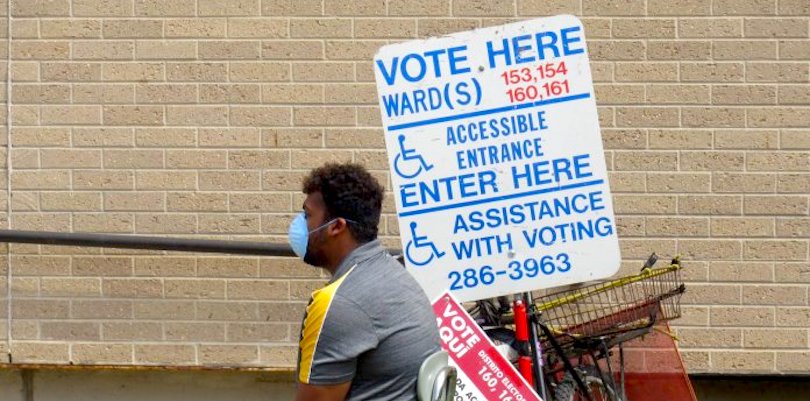
Photo: A Wisconsin poll worker dons a mask to protect against COVID-19. | Isiah Holmes, Wisconsin Examiner

 Daily Updates