

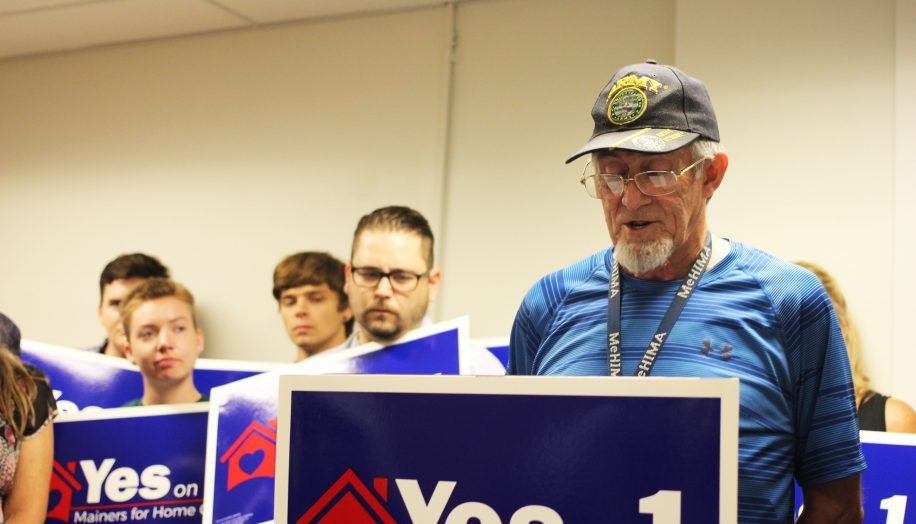
Volunteers and organizations that are part of the Mainers for Home Care coalition officially launched the Yes on Question 1 campaign on Tuesday to guarantee universal access to home care to seniors and Mainers with disabilities, saying the ballot initiative that will go before voters in November represents the best opportunity to fix a broken system.
“We are a grassroots coalition of more than 40 organizations and tens of thousands of individual Mainers who recognized the road we are on as a state is about to take us off a cliff,” said Ben Chin, campaign manager for Mainers for Home Care, which gathered 67,000 signatures last year to place the initiative on the ballot.

“Maine is the oldest state in the country and getting older and thousands of families are finding that the cost of letting their loved ones stay in their homes is impossible to meet,” said Chin. “This campaign represents our best opportunity to change direction, to make sure seniors are not forced from their home when they don’t have to be, and make sure home care work is a career that is respected and valued by being paid a living wage.”
The average annual cost of home care for a senior in Maine was $52,624 in 2017. While that is cheaper than one year in a private room in a nursing home — which cost $117,165 in 2017 — it is out of reach for most Maine families, the organizers say, and Medicare does not cover in-home care.
The ballot initiative proposes funding universal home care for seniors and Mainers with disabilities by narrowing a tax loophole benefiting the wealthiest 1.6 percent of taxpayers.
Projected to raise $180 million annually, the initiative would raise wages for home caregivers and provide support for family caregivers.
Support for families caring for seniors in their homes
In addition to providing in-home care to seniors and disabled Mainers living alone, the program proposes to also fund support for families who are already caring for seniors in their homes. According to the organizers, these families are struggling to earn a living, stretch their household finances, and be available around the clock to provide the care their loved ones need.
Rachel Phipps, a small business owner in Kennebunk, shared her concerns about sustaining her family’s ability to keep her aging mother at home. When Phipps made a promise to her mother to keep her in their home for as long as possible, her mother told her “you’ll have to take me out of here feet first,” Phipps said.
“But I have fears,” Phipps added. “I worry about what would happen when she needs more care, and what that would mean for her and for me, my work, our business, our family’s future, and my promise that she won’t ever have to leave us.”
Phipps says she supports the ballot initiative because it provides families like hers with the basic yet vital support they need to keep a loved one at home, such as helping her mother with walking, moving, exercising, eating, cleaning, and all her medical and non-medical needs.
According to the organizers, these basic yet vital in-home support services are the cost-reducing, early interventions which keep seniors from having to enter nursing homes — yet these are the supports families like the Phipps do not have the time and financial means to provide.
“[These services are] the difference between being forced out of your home and into an institution, or not,” Chin explained. “And so many people much prefer being with their family and being with the community they know. This is an act of basic dignity.”
Caring for Maine’s aging veterans
Half of Maine’s veterans are over the age of 65, according to the U.S. Department of Veteran Affairs. Skip Worcester is a veteran from Hermon, Maine who has volunteered his time in support of the campaign. He said Tuesday that he joined the campaign because his mother was forced into a nursing home against her wishes, and forced to pay down her retirement savings before her nursing home care was covered by Medicare.
He says the home care initiative would also address some of his concerns about how the state is looking after veterans, who sometimes have to endure long waitlists for senior care through Veterans’ Affairs at facilities far from their families.

“A lot of us who served in Vietnam are just now realizing that the VA doesn’t always cover the home care we need, ” said Worcester.
Living wages for Maine’s fastest growing career
Maine’s Department of Labor’s Center for Workforce Research released a report last month that finds that one of the state’s fastest growing sectors for new jobs will be in healthcare, including home caregiving. However, home care workers currently make poverty wages, and two-thirds of home caregivers quit every year, according to organizers. The initiative proposes to raise home caregiver wages by 50 percent.
Leighann Gillis, a home caregiver from Westbrook, spoke about having to work three jobs to stay in a field she considers to be her life calling.
“I refuse to leave a job I love,” Gillis said, adding that the initiative would help create fair compensation for demanding, intimate work that has too long been handled by women at exploitative wages. Professionalizing the compensation of home caregivers would further incentivize young people to stay in the caregiving field and in the state, she said.
“If we want an economy that works, if we want to keep young people in this state, if we care about seniors and people with disabilities being forced out of their homes when they don’t have to be, then we need to pass Question 1 this November,” Gillis told the press.
Taxing individual incomes over $128,400
Organizers also fielded questions from reporters about false claims made by the campaign’s opponents, including the LePage administration, that suggest that instead of taxing individual incomes over $128,400, the initiative would tax combined households incomes over that threshold, creating a “marriage penalty.”
“I’m not surprised that political appointees are trying to play games with this,” Chin told reporters. “You don’t have to take my word for the individual income part, you can look at the fiscal note produced by the Office of Fiscal and Program Review, the only nonpartisan agency that has analyzed this legislation.”
Chin explained that the OFPR report confirms that the law would only apply to individual earners making over $128,400 annually, applying a 3.8-percent tax on 1.6 percent of Maine’s wealthiest individual taxpayers.
In Maine, individuals pay a 12.4-percent combined payroll tax on all their income, while income above $128,400 is not taxed at all. The 3.8-percent tax on income over that amount effectively narrows a tax loophole for the wealthy, which the Question 1 supporters say would make Maine’s tax code more fair while funding a vital service.
The endorsements of Question 1 announced on Tuesday include support from the Maine Alliance for Retired Americans, the Maine AFL-CIO, Caring Across Generations, the Center for Elder Care and Advanced Illness, Holding Hands Home Health Care, Jobs With Justice, the Paraprofessional Health Institute and Bangor Racial and Economic Justice Coalition.
(Top photo: Veteran Skip Worcester speaking in support of the Yes on Question 1 campaign at a press conference on Tuesday.)

 Daily Updates