

Alyce McFadden contributed to this report.
In the third U.S. Senate debate on Thursday evening, Democratic challenger Sara Gideon accused Sen. Susan Collins of duplicity on the issue of health care, noting that she claimed to be a defender of the Affordable Care Act (ACA) while at the same time playing a pivotal role in the legal attacks being leveled against the Obama-era health care legislation.
Collins, Gideon and independents Lisa Savage and Max Linn were asked about their healthcare plans in Thursday evening’s debate hosted by Maine Public.
“You recently said that one of the reasons that you voted against the attempt to repeal the ACA in 2017 is because your party didn’t have a replacement plan ready to be offered,” Maine Public reporter Mal Leary asked Collins. “Given that the ACA could be changed or eliminated depending on what the Supreme Court decides after the election, what would you suggest as a replacement for the ACA?”
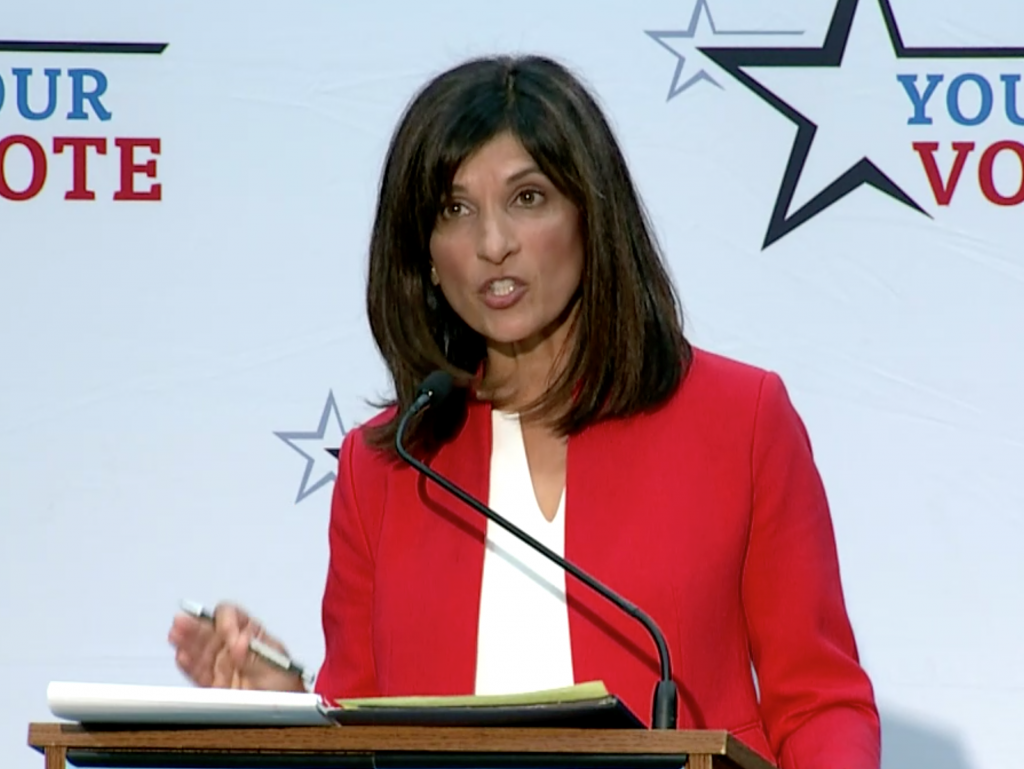
“First of all, I was the deciding vote to retain the ACA,” Collins responded, referring to her 2017 vote to block the ACA repeal. Without answering what sort of replacement she supports, Collins reiterated her opposition to “the individual mandate that was in the ACA before it was repealed was a cruel tax on people who cannot afford to buy health insurance.”
The ACA’s individual mandate, which required every American to enroll in a health insurance program, was done away with by the GOP’s $1.5 trillion tax bill in 2017 — whith Collins casting a decisive vote in support. A group of Republican state attorneys general are suing the federal government, alleging that the tax vote made the ACA unconstitutional by eliminating the mandate.
Gideon highlighted Collins’ role in the legal argument behind that case, now before the Supreme Court.
“Susan Collins cannot have it both ways,” Gideon said. “She cannot say that she has supported pre-existing conditions when she voted for the tax bill that took the individual mandate away when she knew that that would make the law potentially unconstitutional.”
Gideon added, “You signed on to an amicus brief stating exactly that and that is why that lawsuit is there right now.”
Gideon was referring to an amicus curiae brief — a “friend of the court” legal document — that Collins and 35 other U.S. senators signed on to in 2010 in the case of Florida v. Department of Health and Human Services. In that filing, authored by Senate Majority Leader Mitch McConnell, the lawmakers argued that the individual mandate is central to the Affordable Care Act and that the entire ACA should be struck down if the mandate is removed. The Trump administration has used that document to argue that Collins and other lawmakers knew what they were doing to undermine the ACA when they voted for that change.
Gideon said Collins has failed to be clear with Mainers about her health care plan should the ACA be struck down.
“Over the course of 15 months,” Gideon continued, “what I have heard from people over and over again is that they are scared about their health care and their health. How scared they are right now that their health insurance is going to be taken away. That’s because President Trump has made it his mission to destroy the Affordable Care Act, moving forward with a lawsuit — that is made possible by Senator Collins’ vote on the tax bill — even during the course of a pandemic.”
“Now look, right now we need leadership on the federal level and we need to know that no matter what happens to the ACA we have a Congress that is in place that is actually going to protect and expand health care,” Gideon added. “Mitch McConnell and Susan Collins have said there is no plan in place, even as that lawsuit moves to oral arguments the week after the Election Day.”
‘The people want real healthcare’
Gideon has endorsed a public option for health insurance, a policy that is broadly popular with Mainers and voters across the country. Collins said during the debate that she does not support such a program.
 Gideon also supports, and Collins opposes, allowing Medicare to negotiate prescription drug prices, a reform that is extremely popular among Maine voters. An August survey report by Data for Progress found that 70 percent of voters in Maine are more likely to cast their ballot for a candidate who supports legislation to allow Medicare to work with drug companies to lower prescription costs.
Ann Woloson, executive director of Maine Consumers for Affordable Healthcare (MCAH) praised the plan following its release this August.
“In our opinion, it is quite comprehensive and bold,” Woloson said of the agenda. “I think she is quite serious and sincere about doing what she can to improve access and affordability.”
Savage favors a single-payer insurance system, like the Medicare for All legislation backed by most progressive Democrats and introduced most recently in bills by Rep. Pramila Jayapal (D-Wa.) and Sen. Bernie Sanders (I-Vt.).
Universal health care is broadly popular among Maine Democratic voters — a CNN exit poll of voters in the Democratic primary in March found that 69 percent supported such a program.
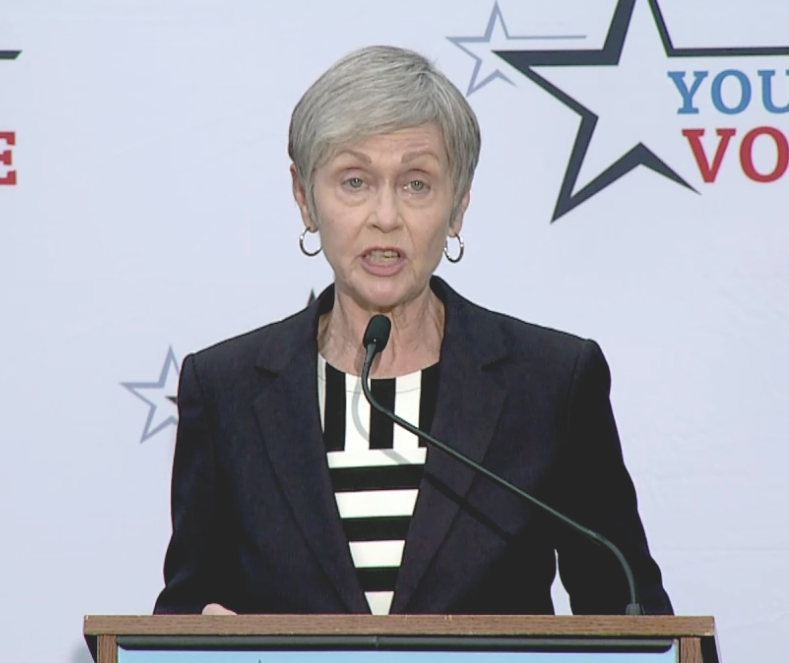
During Thursday’s debate, Savage said that when politicians accept political contributions from insurance companies, they “put profit into health care and make it into a commodity rather than a human right.”
“The people want real health care,” Savage continued. “They don’t want health insurance, they want health care that they can afford to use and they can count on when someone in their family becomes seriously ill so that they do not lose their home or lose their life savings because of an illness.”
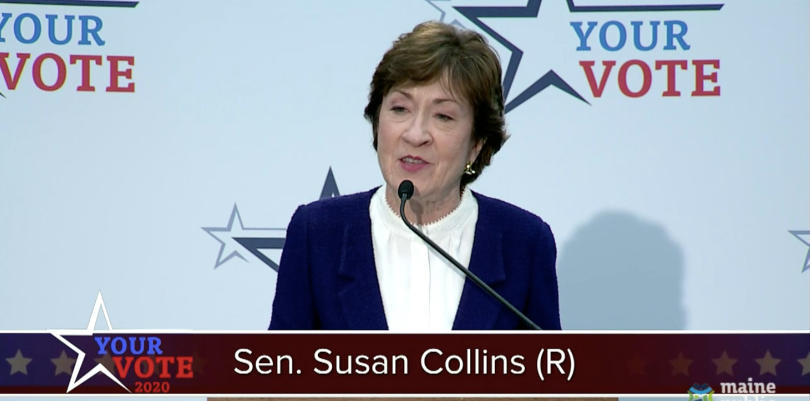
Sen. Susan Collins takes part in a debate on Oct. 15, 2020. | Screenshot via Maine Public

 Daily Updates