

Maine is home to a large proportion of seniors who in a few years will be facing the critical question of whether they can remain in their homes. The largest obstacle for those who want to stay is often finding consistent, quality care and new research shows that is becoming increasingly difficult. According to a new benchmark study, annual turnover in the homecare industry has risen to more than two thirds, with poverty wages paid to those caring for seniors and people with disabilities being the main driver of the trend.
According to the annual Home Care Benchmarking Study conducted by industry research firm Home Care Pulse, 67 percent of caregivers left their jobs in 2017. The group, which surveyed 730 care providers, found that the spike was tied closely with low pay.
Homecare advocates in Maine say the study underscores the need, particularly in the nation’s oldest state, for the Homecare for All citizen initiative, which would guarantee that homecare is available for all seniors and Mainers with disabilities while increasing wages for homecare workers and providing support for family caregivers.
On Wednesday, Maine Secretary of State Matt Dunlap released initial language for the referendum question, which will appear on the November ballot. The question currently reads: “Do you want to create the Universal Home Care Program, which will provide services to people with disabilities and senior citizens who need daily assistance in their homes, funded by a new tax of 3.8 percent on individual income over $128,400?”
The 1.9 percent employee and employer payroll tax would narrow a loophole that currently benefits only the wealthiest 1.6 percent. Currently, those making less than $128,400 a year pay a 6.2 percent payroll tax on all their income.
Miri Lyons, a family caregiver and former homecare worker in Boothbay Harbor, said that Mainers on the one hand “are wondering how they are going to care for their parents or loved ones,” while “looking at the system we have now and saying ‘this isn’t right.'”
Lyons said that with the citizen initiative, “there’s hope.”
“I’m proud to be part of this grassroots campaign to improve the lives of tens of thousands of Mainers,” she said. “We can make sure seniors aren’t forced from their homes and at the same time make sure homecare workers are able to support their families.”
Caregivers, companions, and certified nursing assistants (CNAs) provide essential services like bathing, feeding, dressing, grocery shopping, cooking, and in some cases administer medication, as well as more holistic care such as companionship and socialization. A compassionate and well-trained care worker can increase the quality of one’s later life substantially.
Despite that great responsibility, they are often paid just above minimum wage, given inconsistent schedules and provided little to no benefits, including paid sick leave.
Low pay may be exacerbated in Maine as the legislature failed to make an appropriation to raise direct care reimbursement rates this year, despite bipartisan support.
Last year, caregivers nationally were paid between $150 to $174 for a 24-hour shift, which amounts to $6.25 and $7.25 respectively. And according to the benchmark study, this rate has not changed in the past three years. Personal care attendants, CNAs, and those who provided companion/homemaker services were paid a bit more ($11.50 to $11.99 an hour in 2017 for the highest-paid CNAs).
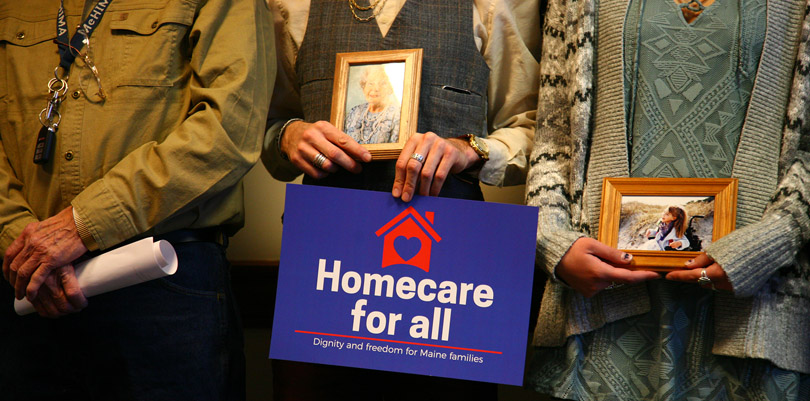
Advocates carried pictures of aging loved ones when they delivered 67,000 signatures to the Maine Secretary of State’s office to secure the Homecare for All citizen initiative.

 Daily Updates