

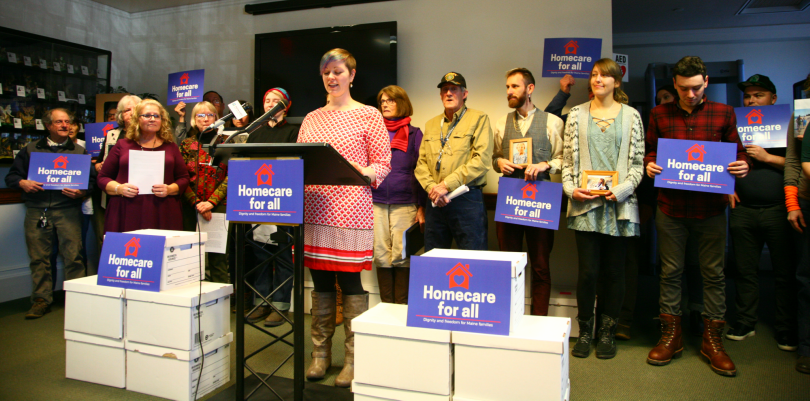
With the release of ballot question language for the Homecare for All citizens’ initiative from the office of Maine’s Secretary of State on Monday, grassroots supporters marked another step forward in the campaign to guarantee that senior citizens and Mainers with disabilities can receive the assistance they need to stay in their homes.
“Seeing it come on the ballot is exciting,” said Miri Lyons, a former homecare worker and current family caregiver from Boothbay Harbor. “It’s a culmination of all our work.”
Debra Bourque of Biddeford similarly said that she’s glad that Mainers who want to stay in their homes or care for their family members, but can’t afford it, might soon see some relief. After her husband was diagnosed with Alzheimer’s at the age of 57, Bourque said she struggled to care for him and keep her cleaning business afloat.
“That one cruel twist of fate has changed the path of our lives forever,” she said. “Money is tight to pay for care he needs, and whatever money we had saved for retirement is quickly depleting. We need to make sure Maine seniors can live with their families, in their own homes, and on their own terms.”
Lyons was among the hundreds of volunteers who gathered almost 70,000 signatures to place the universal homecare measure on the ballot this November. If passed, it would narrow a tax loophole benefiting the richest 1.6 percent in order to guarantee that homecare is available to all Mainers who need it. The measure would also raise wages for care workers.
Currently, care workers are paid low wages, work per diem, and are not guaranteed a full 40 hours of work per week, meaning their paychecks often aren’t enough to support their own families. This insecurity has caused the industry to experience high rates of turnover, with 67 percent of care workers leaving their jobs last year.
“Imagine trying to feed your kids and pay your bills on time when your income is unsteady,” Lyons said. “If the person you’re caring for needs to be seen at a hospital for a few weeks, you lose hours, and your employers aren’t obligated to give you hours.”
Specifically, the ballot question will read: “Do you want to create the Universal Home Care Program to provide home-based assistance to people with disabilities and senior citizens, regardless of income, funded by a new 3.8% tax on individuals and families with Maine wage and adjusted gross income above the amount subject to Social Security taxes, which is $128,400 in 2018?”
As the question notes, the universal system is paid for by creating a 1.9% employer and employee payroll tax on individual income above $128,400. Currently, high-income earners pay no payroll tax at all on earnings above that level while those making less pay 6.2% on all their income.
While the removal of the exemption only impacts a small portion of the Maine population, Lyons noted that everyone, whether they realize it or not, is connected to the caregiving community.
“Someday, we will age,” she said. “It should be our choice to stay home.”
Miri Lyons, a former homecare worker and campaign volunteers, addresses the crowd before helping deliver petition signatures to the Secretary of State.

 Daily Updates